


Tips for Skin: How to Shed Wrinkles Naturally
When faced with the issue of wrinkling, there exist two solutions: one is the external and the other is the internal treatment. The external method is by the application of creams and lotions which are aimed at the skin surface to make it look less wrinkled. The internal method, contrastingly, is all about feeding the…
When faced with the issue of wrinkling, there exist two solutions: one is the external and the other is the internal treatment. The external method is by the application of creams and lotions which are aimed at the skin surface to make it look less wrinkled. The internal method, contrastingly, is all about feeding the body with the right foods which will keep the skin healthy from the inside.
Successful anti-aging is a dual strategy. Topical treatments are combined with nutritional and lifestyle changes from inside [1]. The inside approach is all about cell health. It goes to the very roots of skin aging.
INFORMATIONAL NOTE:
This content is for informational and motivational purposes only. Before making significant changes to your diet, exercise routine, or lifestyle, please consult with a qualified professional (such as a doctor, nutritionist, or trainer).
Tips for Skin: The Inward Strategy
Me, I would go for the internal approach in a wrinkle battle. Even though a lot of anti-wrinkle products utilising retinol, an artificial vitamin A, may be found on the market, I maintain that supplying the organism with the proper dietary needs is a more potent and natural method of achieving healthy skin.
Retinol is the best anti-wrinkle compound on the planet. It is one of the Vitamin A derivatives [2]. Although the use of retinoids on the skin is the most direct and effective way, taking Vitamin A in the diet is still very important. It helps the body to renew skin cells and heal itself [2].
What Makes Skin Turn to Need Vitamin A
Without doubt, vitamin A is one of the most important nutrients that the skin needs to be kept in a good condition. It protects the skin from acne, scars, and other problems, and it also makes the skin fresh and vibrant in color. Does it take the shape of food to come with vitamin A? To answer that, firstly, add egg yolks for your daily meal. Egg yolks are loaded with this vital vitamin; therefore, do not be limited to egg white only.
Pretty soon you will come to find that vitamin A can come from different sources. Butter obtained from cows fed with natural grass is a good example. Seek for top-notch butter made of cows that have been fed in the pasture. In addition, cod liver oil is a source of both vitamin A and vitamin D. These vitamins are fat-soluble and are a must for the body and they may put the skin health in a good place.
Without a doubt, vegetables serve as an excellent source of vitamin A. Still, one should not forget that by consuming vegetables, we are actually ingesting carotenoids that are the precursors of vitamin A. Provitamin A carotenoids are changed into active vitamin A in the organism. Hence, having provitamin A is good, yet it is still necessary to have some other sources of vitamin A in your diet.

There are two different types of Vitamin A: one is preformed Vitamin A (Retinol), and the other is provitamin A (Carotenoids) [3]. Retinol can be found in animal products such as egg yolks and liver [3]. The body is easily absorbed and utilized it. Carotenoids, which are present in vegetables, have to be converted into Retinol. The conversion process is very often inefficient, and it changes a lot from one person to another [3]. So, eating animal sources of Retinol is the safest way to make sure that you have enough Vitamin A for the skin.
The Benefits of a Comprehensive Approach
Surely, one can take enough vitamin A from some particular foods, but I personally suggest going a comprehensive way and bringing into the diet the mixture of different provitamin A carotenoids plus other phytonutrients. These molecules have protective properties that are highly necessary for the skin of your body.
One mixture that I especially like is kale and parsley. The reason why I do not eat a lot of spinach is that it can raise the level of oxalates thereby causing kidney stones. But, kale and parsley are great together. You can mix them together with some water and blueberries and make a nutritious shake. The phytonutrients coming from this mixture are capable of doing miracles for your skin.
Phytonutrients and carotenoids are very effective antioxidants. They defend the skin against UV-induced oxidative stress [4]. Although spinach has oxalates, it is still usually safe for the majority of people. The risk of kidney stones, in fact, is only for those who have a predisposition to it or consume it in large amounts [5]. The healthiest approach is to eat a variety of colorful fruits and vegetables. This guarantees the availability of a wide range of protective phytonutrients.
What to Avoid
When aiming for skin health, it depends not only on what you eat but also on what you don’t eat. There are some things that could be a source of harm to the skin, and one of these is high insulin levels. In particular, it is critical to maintain insulin levels very closely if one has prediabetes, diabetes, or insulin resistance. These diseases can absorb collagen peptides and vitamin A in the body in such a way that as you age, the situation becomes more difficult to handle. So dealing with this issue will not only stop the problem but actually will be one of my top tips for skin to look younger.
Along with controlling insulin levels, you can take more initiatives in order to have beautiful skin, such as sugar removal from the diet. A ketogenic diet plus intermittent fasting will also be of great help. Autophagy is activated during intermittent fasting and it is the recycling of the old cells process. The skin will be refreshed and will appear better in this way.
Excess insulin levels really speed the skin aging process. They do so by enhancing the glycation process [6]. Glycation is the binding of sugar molecules to collagen and elastin. Consequently, the formation of Advanced Glycation End-products (AGEs) occurs [6]. AGEs are the substances that make the skin structural proteins stiff and drylike. They cause the skin to wrinkle and become less elastic. Partially fasting is good for the skin. It makes the skin undergo autophagy, which is a purification process at the cellular level [7]. Autophagy is the process that liberates the skin from the old cellular components.
Conclusion
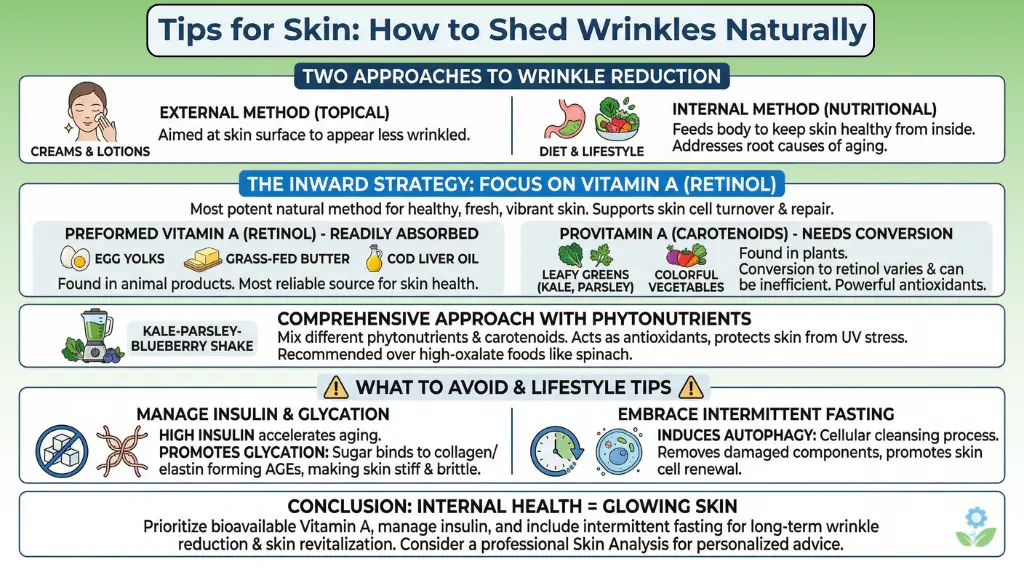
The tips for skin, which mainly involved feeding the body from the inside, are just a step away from you having a glowing skin. By focusing on foods rich in vitamin A such as egg yolks, grass-fed butter, and kale-parsley shakes, while at the same time keeping away from high insulin levels and including intermittent fasting in your lifestyle, you will be able to not only lessen wrinkles but also to revitalize your skin. For individual skin care advice, consider using our Skin Analysis tool to know your skin type and get the care that suits you best. Why not now?
Achieving naturally smooth skin is a reflection of internal health. It is not just external treatment. By prioritizing bioavailable Vitamin A and managing insulin-driven glycation, you support the fundamental structure of your skin.
References
- Hyaluronic acid: A key molecule in skin aging. P. Papakonstantinou, M. Roth, & G. Karakiulakis. (2012). Dermato-Endocrinology. [URL: https://www.tandfonline.com/doi/full/10.4161/derm.21923]
- Retinoids in the treatment of skin aging: an overview of clinical efficacy and safety. Mukherjee, S., et al. (2006). Clinical Interventions in Aging. [URL: https://pmc.ncbi.nlm.nih.gov/articles/PMC2699641/]
- Vitamin A and Carotenoids – Health Professional Fact Sheet. National Institutes of Health (NIH ), Office of Dietary Supplements (ODS). [URL: https://ods.od.nih.gov/factsheets/VitaminA-HealthProfessional/]
- Carotenoids: from food to skin. D. Weber, et al. (2023 ). Redox Report. [URL: https://rem.bioscientifica.com/view/journals/rem/2023/1/REM-23-0019.xml]
- Dietary oxalate and kidney stone formation. Mitchell, T., Knight, T., & Gannon, J. (2019). American Journal of Physiology. [URL: https://pmc.ncbi.nlm.nih.gov/articles/PMC6459305/]
- Accumulation of advanced glycation end products in the skin is accelerated in relation to insulin resistance in people with Type 1 diabetes mellitus. C. Chen, et al. (2022). Diabetes/Metabolism Research and Reviews. [URL: https://onlinelibrary.wiley.com/doi/abs/10.1111/dme.13921]
- Fasting: Molecular Mechanisms and Clinical Applications. V. D. Longo & M. P. Mattson. (2014 ). Cell Metabolism. [URL: https://www.cell.com/cellmetabolism/fulltext/S15504131(13)005032]
- The Role of Advanced Glycation End Products in Aging and Metabolic Diseases. J. Chaudhuri, et al. (2018). Cell Metabolism. [URL: https://www.sciencedirect.com/science/article/pii/S1550413118305151]


