

How to Relieve Menstrual Cramps: Natural Solutions
Menstrual cramps are basically the same as menstrual spasms or period pains that are usually localized in the lower part of the belly. These spasms are caused by contractions in the uterus. The uterus, like it does during childbirth, contracts even when it is a monthly cycle. Primary dysmenorrhea is the medical term for this…
Menstrual cramps are basically the same as menstrual spasms or period pains that are usually localized in the lower part of the belly. These spasms are caused by contractions in the uterus. The uterus, like it does during childbirth, contracts even when it is a monthly cycle.
Primary dysmenorrhea is the medical term for this common condition which maybe different in severity but which is reported by nearly 90% of people who have their periods and is a major cause of discomfort and decreased quality of life [1].
In case you are having menstrual cramps, you can relieve them in a moment and with only one method that is both quick and simple. Find a comfortable spot on the floor, bed, or sofa and lie on your stomach in the prone position. Place your hands on the floor in front of you and slightly curve your back. This position immediately relaxes the stretched uterus. You may be feeling so much pain that it is hard for you to do it, but nonetheless, it is worth a try. Do, however, remember not to over-stretch excessively during the day.
While positional changes can offer temporary relief, the most evidence-based, non-pharmacological approach for immediate pain management is the application of heat [6]. Heat therapy, such as using a heating pad or hot water bottle on the lower abdomen, has been shown to be as effective as over-the-counter pain relievers like ibuprofen in reducing menstrual pain [6]. The heat is very helpful to relax the uterine muscles and also to increase the blood flow and that is why it is working against the chemicals that cause the contractions.
⚠️ IMPORTANT DISCLAIMER:
This information is not intended to be a substitute for professional medical advice, diagnosis, or treatment. The content of this article is for informational purposes only. Always seek the advice of your physician or other qualified health provider with any questions you may have regarding a medical condition. Never disregard professional medical advice or delay in seeking it because of something you have read on this site.

How to Relieve Menstrual Cramps with Prostaglandins Management 🧬
While investigating menstrual cramps, you might find the term “prostaglandins”.
Prostaglandins are components in the body that send signals to other body parts and thus something specific happens there.
For the case of menstrual cramps, it is certain prostaglandins that are the main causes for the uterine contractions. Too much prostaglandins can be the reason for intense pain. Specifically, primary dysmenorrhea is caused by the excessive production of prostaglandin F2α (PGF2α) in the endometrial tissue [1]. Prostaglandins of this kind are the ones that are brought about by the shed of the uterus lining and they provoke the contractions of the uterine hard. So, these contractions tend to press the blood vessels and this is why the pain of the cramping that is typical for the period is experienced [7].
Why not find the ways of blocking or lessening the level of prostaglandins without painkillers?
Cinnamon: A Natural Remedy 🌿🧂
One of the best-known alternatives to normal analgesics is undoubtedly cinnamon. Combine cinnamon powder with sugar, put it on toast and eat it. Of course, this is only a jolly way to say it.
Actually what you need is three doses a day of taking 1,000 mg of cinnamon in capsule form. Cinnamon is one of the most stable natural products even though it contains quite a few different properties among them the regulating of sugar level in blood. Here it serves as an anti-inflammatory by lowering the level of prostaglandins that cause the uterus to contract.
Clinical research supports the use of cinnamon as a natural intervention for primary dysmenorrhea [2]. The finding from the meta-analysis and systematic review of random controlled trials is that cinnamon is a very effective agent in lessening the painful sensation of menstruation and also in making the painful period shorter [2]. The suggested dosage of 1000 mg (1 gram) of cinnamon powder, taken three times daily for the first three days of the menstrual cycle, is a common and effective protocol used in clinical studies [2].
Addressing Hormonal Imbalance 🩸⚖️
Perhaps, you might be thinking what causes the increase of prostaglandins in the first place. The reason is that it is a hormonal imbalance between two hormones: progesterone and estrogen.
The problem occurs when the level of progesterone is reduced very much and the level of estrogen is still high. Without a doubt, cinnamon not only changes prostaglandins but also balances estrogen levels and raises progesterone levels. It is not just a simple prostaglandins reduction but has a deeper impact. While the primary cause of pain is prostaglandin release, the underlying hormonal environment is complex [7]. Estrogen dominance (high estrogen relative to progesterone) is mainly linked with heavier periods and increased prostaglandin production, and cinnamon may be indirectly modulating the situation through its anti-inflammatory properties [2].
Additional Remedies 💊🍵
Besides using cinnamon, you can also use some other remedies that block prostaglandins directly. Vitamin D3 is one of the agents to block prostaglandins and can be used in a dose of around 10,000 IU three times a day. Do it together with your cinnamon dose.
Even though the severity of menstrual pain was considerably alleviated by the Vitamin D supplement, it is still regarded an extremely high and possibly unsafe daily dose to be 30,000 IU for long periods of time [3]. Evidence-based studies for dysmenorrhea typically use a single high dose (e.g., 300,000 IU once per cycle) or a weekly dose of 50,000 IU for 8-12 weeks, which is safer and effective in reducing pain intensity [3]. Always consult a healthcare provider before starting high-dose Vitamin D supplementation to determine the appropriate and safe dosage for your individual needs.
Calcium and magnesium when taken simultaneously, have a better effect on the absorption of these minerals in tissues, where they remove spasms. Omega-3 fatty acids such as those present in cod liver oil are also natural pain-relievers and anti-inflammatory agents.
Magnesium is a natural muscle relaxant. Magnesium can help reduce the intensity of uterine contractions [4]. Calcium is the main mineral often combined with the studies on vitamin D. It is necessary for muscles to work and for nerves to signal [4]. Systematic reviews indicate that Magnesium supplementation (e.g., 250 mg daily) may noticeably alleviate the intensity of menstrual pain [4].
Omega-3 Fatty Acids: One of the most powerful anti-inflammatory agents is Omega-3 Polyunsaturated Fatty Acids (PUFAs), e.g., the ones in fish oil [5]. They work by altering the balance of prostaglandins, favoring the production of less inflammatory types [5]. A meta-analysis of randomized controlled trials provided evidence that Omega-3 supplementation has a significant effect in lowering the pain intensity of primary dysmenorrhea [5].
Conclusion
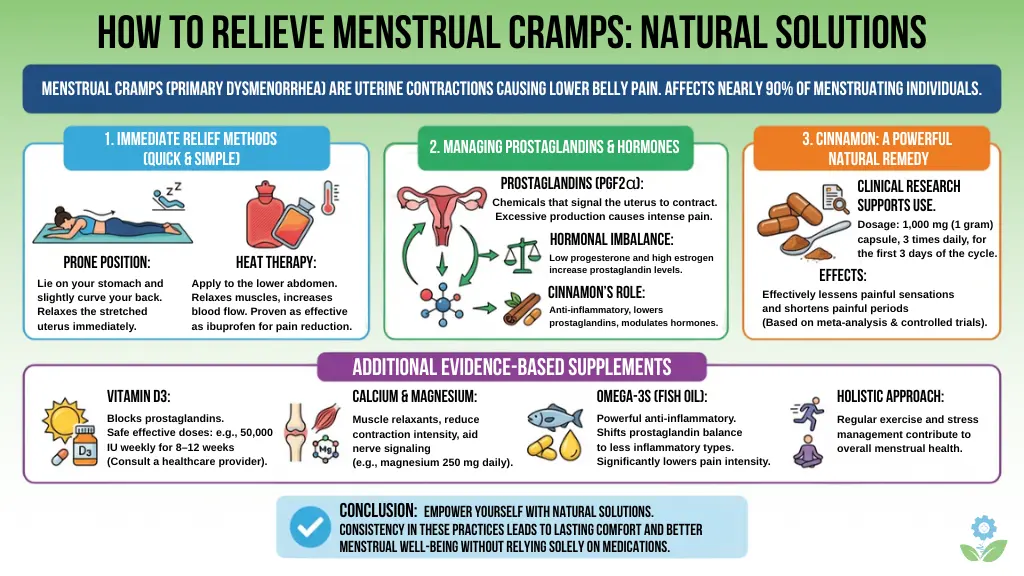
Relieving menstrual cramps naturally is achievable through simple positions, targeted supplements like cinnamon, and addressing hormonal imbalances.
By learning how to relieve menstrual cramps with these methods, you empower yourself to manage pain effectively without relying on medications. Consistency in these practices can lead to lasting comfort and better overall menstrual health.
Using lifestyle changes like regular exercising and stress management together with these natural remedies gives a full way of dealing with primary dysmenorrhea and makes the general well-being better [7].
You can find even more useful articles on this blog.
References
- Primary Dysmenorrhea: Pathophysiology, Diagnosis, and Management. R Itani, et al. (2022). PMC – PubMed Central. [URL: https://pmc.ncbi.nlm.nih.gov/articles/PMC8943241/]
- Efficacy of herbal medicine (cinnamon/fennel/ginger ) for primary dysmenorrhea: a systematic review and meta-analysis of randomized controlled trials. Y Xu, et al. (2020). Journal of International Medical Research. [URL: https://journals.sagepub.com/doi/10.1177/0300060520936179]
- Effect of vitamin D supplementation on primary dysmenorrhea: A systematic review and meta-analysis of randomized clinical trials. YC Chen, et al. (2023 ). Nutrients. [URL: https://www.mdpi.com/2072-6643/15/13/2830]
- Role of vitamin D and calcium in the relief of primary dysmenorrhea: a systematic review. F Abdi, et al. (2021 ). Journal of Menopausal Medicine. [URL: https://pmc.ncbi.nlm.nih.gov/articles/PMC7834752/]
- The impact of omega-3 polyunsaturated fatty acids on primary dysmenorrhea: a systematic review and meta-analysis of randomized controlled trials. MM Mohammadi, et al. (2022 ). European Journal of Clinical Nutrition. [URL: https://link.springer.com/article/10.1007/s00228-021-03263-1]
- Heat therapy for primary dysmenorrhea: A systematic review and meta-analysis of its effects on pain relief and quality of life. J Jo, et al. (2018 ). Scientific Reports (Nature). [URL: https://pubmed.ncbi.nlm.nih.gov/30389956/]
- Dysmenorrhea: Painful Periods. American College of Obstetricians and Gynecologists (ACOG ). [URL: https://www.acog.org/womens-health/faqs/dysmenorrhea-painful-periods]


