

How to Stop Premature Graying: Slow Down Hair Aging
We will talk in this blog about two very impactful things that would help you learn how to stop premature graying and slow down the aging process of your hair.The motive of this blog is to demonstrate to you how to prevent premature graying of hair. It is a matter not only of genetics, though…
We will talk in this blog about two very impactful things that would help you learn how to stop premature graying and slow down the aging process of your hair.
The motive of this blog is to demonstrate to you how to prevent premature graying of hair. It is a matter not only of genetics, though genetics has something to do with it, but also of epigenetics – what we do to our hair.
Premature hair graying (PHG) refers to the condition of hairs turning gray before a person’s age of 20 in the case of Caucasians, 25 in the case of Asians, and 30 in the case of Africans [1]. Although genetics is basically responsible for the onset of graying, epigenetic factors – environmental and lifestyle influences – still have a considerable effect on the volume and aggravation of the process.
INFORMATIONAL NOTE:
This content is for informational and motivational purposes only. Before making significant changes to your diet, exercise routine, or lifestyle, please consult with a qualified professional (such as a doctor, nutritionist, or trainer).
How to Stop Premature Graying with Copper 🧑🦳⚗️
The first thing you have to find out is the pigment in your hair that makes it colored. The enzymes that produce this pigment rely on a very small component called copper. A copper shortage may bring about the occurrence of premature graying. So, what is the cause of copper deficiency? Copper deficiency may result from a wrong diet that is devoid of foodstuffs rich in copper.
Haircolor pigment is melanin, which is one of the most isolated pigments produced by special cells called melanocytes in the hair follicle [2]. Tyrosinase is the main enzyme in this carbon assimilation process and it is a copper-dependent enzyme [2]. So, if there is a lack of copper, which is necessary for the enzyme, the activity of tyrosinase will be impaired resulting in less melanin production and hence a younger gray hair [3]. Experimental designs very often demonstrate that the copper level in the blood of people with PHG is dramatically lower as compared to the group of normal hair aging [3].
In the following section, I will disclose to you the foods that are the richest in copper.
Foods Rich in Copper 🦪
If you aim at getting more copper out of your diet, you should first focus on including foods rich in this trace element in your daily meals. All sorts of seafood, and particularly shellfish such as oysters, are the best ones. Apart from these, copper is also in mushrooms and organic beef liver.
In case you are a vegan, you may obtain copper from spirulina or other plant-based sources.
Excellent plant-based sources of copper also include sesame seeds, cashews, sunflower seeds, and dark chocolate.
Stress and Its Influence on Gray Hair 😩🧠
Long exposure to cortisol, a hormone initiated by stress, can result in the deprivation of copper in the body. Copper is one of the most crucial parts of a number of enzymes, among them tyrosinase, which contributes to the production of melanin, the pigment that makes hair naturally colored. Hence, the more the stress, the more the graying. The only way to lower copper levels is to reduce stress and you can also get more copper from food.
One of the most recent and significant studies has mapped out the biological pathway that connects psychological stress to hair graying [4]. When the stress is sensed, the body’s sympathetic nervous system (the “fight-or-flight” response”) is put in action and a neurotransmitter called norepinephrine is released [4]. Norepinephrine signals the pigment-producing one-of-stem cells (melanocyte stem cells) in the hair follicle to differentiate and migrate out of the follicle at a very high speed, thus practically emptying the “reservoir” of color-producing cells [4].
As a result, the particular follicle loses its pigment capacity forever. However, some studies are of the opinion that if the stressful situation is removed quickly enough, it may be possible to reverse the graying caused by short-term stress [5].
I would not advise you to take copper in the form of supplements, it is much better to get it from food. Copper supplements, however, may be taken but they should also have other trace minerals, especially zinc. Keep in mind that the ratio of zinc to copper is very important – one to ten. You don’t have to take a lot of copper, just enough to be able to get it in sufficient.
The stated ratio of 1:10 (Copper:Zinc) is incorrect and potentially misleading for supplementation. Zinc and copper compete with each other for absorption in the body, and if zinc is taken in excess, it can result in a secondary deficiency of copper [6]. The ratio that is more often suggested and also safer for supplementation is around 8:1 to 15:1 (Zinc:Copper), and quite a few healthcare providers advise a 10:1 ratio for keeping the balance [6]. What is most important is to see a medical professional before supplementing to be sure of the right balance of trace minerals.
Reduce Stress Levels and Live a Healthy Lifestyle 🧘♀️💚
Even if you eat well, it is still a must to reduce your stress if you want your hair to remain healthy and the aging process to be slow. Try to manage your stress, be in good shape, don’t worry too much about your problems, and keep away from smoking, alcohol, and the likes like fast food, sugar, and other empty carbohydrates. A diet that is low in fat is also not good.
One of the major factors that cause the hair to age is chronic oxidative stress that is frequently made worse by an unhealthy diet, smoking, and chronic psychological stress [7]. Changes in lifestyle such as engaging in physical exercises regularly, being on the lookout through mindfulness, and taking a diet full of antioxidants are necessary to reverse or stop the harm.
Catalase and Slowing Down the Aging Process of Hair 🧬🧑🦳
Copper isn’t the only thing that the enzyme catalase also makes a major contribution to the slowing of human hair aging. Catalase is the enzyme that cleanses hydrogen peroxide, a compound that builds up in the hair as one gets older and causes graying. If you want to increase the amount of catalase in your body, you should eat foods that have this enzyme in them.
The buildup of hydrogen peroxide (H₂O₂) in the hair follicle has been known for a long time as one of the main causes of hair graying [7]. H₂O₂ is a strong oxidant that lightens the hair pigment and destroys the melanocytes [7]. Catalase is the enzyme that breaks down H₂O₂ into water and oxygen, but its activity gradually decreases with age [7]. This decrease is what causes an imbalance leading to a situation in which H₂O₂ can accumulate and thus, the process of graying can take place.
Foods Rich in Catalase 🥦
Catalase is a protein that can be extracted from the liver of a grass-fed calf and other plant parts, mostly from the family of cruciferous vegetables (cabbage, broccoli, cauliflower).
A lot of catalase is also present in sprouts and microgreens. Put microgreens or sprouts in your salad to get an additional serving of catalase. There are a few foods that have little amounts of catalase; however, the enzyme is mostly broken down during digestion, thus, eating catalase-rich foods cannot be considered a reliable way to increase catalase levels in the hair follicle [7]. The best way to fight oxidative stress is to consume a diet full of antioxidants in general (Vitamins C and E, Selenium) and substances that help the body’s own antioxidant defenses.
Conclusion
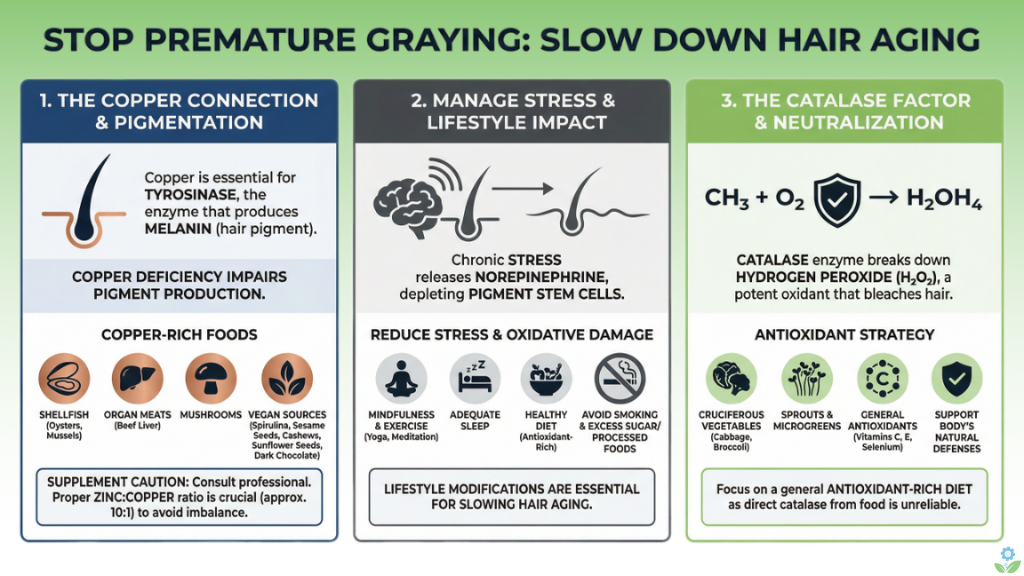
Here in this article, we have considered the two major factors that will enable you to learn how to stop premature graying and slow down your hair aging process. Stress reduction and healthy eating, including foods rich in copper and catalase, will basically do the trick of keeping your hair healthy and young.
The best, scientifically proven method for handling PHG is a multi-faceted approach: first, by guaranteeing the supply of essential micronutrients such as copper and zinc; second, by relieving chronic mental stress; and third, by taking a diet rich in antioxidants to fight the oxidative damage that is the main cause of aging [3] [4] [7].
Also, a healthy lifestyle and the right attitude towards life will not be left behind in making your hair beautiful and healthy.
We recommend trying our free tool — Hair Type Quiz, where you’ll receive personalized hair care instructions based on your test results.
- Premature Graying of Hair: Review with Updates. AB Kumar, et al. (2018). International Journal of Trichology. [URL: https://pmc.ncbi.nlm.nih.gov/articles/PMC6290285/]
- Premature hair graying: a multifaceted phenomenon. D. Desai. (2024 ). International Journal of Dermatology. [URL: https://onlinelibrary.wiley.com/doi/10.1111/ijd.17580]
- Relationship between Trace Elements and Premature Hair Graying. AM El-Sheikh, et al. (2018 ). International Journal of Occupational and Environmental Medicine. [URL: https://pmc.ncbi.nlm.nih.gov/articles/PMC6369637/]
- How stress causes gray hair. NIH Research Matters. (2020 ). National Institutes of Health (NIH). [URL: https://www.nih.gov/news-events/nih-research-matters/how-stress-causes-gray-hair]
- Quantitative mapping of human hair greying and reversal in relation to life stress. AM Rosenberg, et al. (2021 ). eLife. [URL: https://elifesciences.org/articles/67437]
- Understanding The Zinc:Copper Nutrient Ratio. Thorne Health. (2025 ). Health-care Practitioners Recommendation. [URL: https://www.thorne.com/take-5-daily/article/supplementing-with-zinc-and-copper-a-balancing-act?srsltid=AfmBOorSfaLyPOPsHRAPeDc4EV_t1K61QM9HTkU2KNcSOVGQUO3eSLxx]
- Senile hair graying: H2O2‐mediated oxidative stress affects human hair color by blunting methionine sulfoxide repair. JM Wood, et al. (2009 ). The FASEB Journal. [URL: https://faseb.onlinelibrary.wiley.com/doi/abs/10.1096/fj.08-125435]


