

Ways to Fall Asleep: Proven Methods for Healthy Sleep
Today we will tell you about ways to fall asleep that you maybe didn’t know yet. With these methods you will be able to rest and learn how to get healthy sleep like little children. Good sleep is one of the essential positive factors for health, which in turn has a significant impact on brain…
Today we will tell you about ways to fall asleep that you maybe didn’t know yet. With these methods you will be able to rest and learn how to get healthy sleep like little children. Good sleep is one of the essential positive factors for health, which in turn has a significant impact on brain power, emotional strength, and bodily repair [1].
INFORMATIONAL NOTE:
This content is for informational and motivational purposes only. Before making significant changes to your diet, exercise routine, or lifestyle, please consult with a qualified professional (such as a doctor, nutritionist, or trainer).
Lowering the Temperature 🌬️😴
The first method among ways to fall asleep is a drop in temperature in the room. This method is very effective for me. If you go to sleep at an ambient temperature of 20 degrees, you are definitely going to have a longer and more restful sleep than if you slept in a warm room. Thermoregulation has been scientifically proven to be one of the main factors leading to sleep onset, as lowering core body temperature is a typical way for the brain to realize that sleep is coming [2].
Usually, the best temperature for sleeping is around 18–20°C (65–68°F) because this range makes it easier for the body to cool down from the inside, which is a condition for both falling asleep and staying in the deep sleep stages [3]. The body uses this mechanism, called distal vasodilation, to release heat by dilating blood vessels in the extremities (hands and feet) thus allowing the heat to be carried away from the core of the body in a more efficient way [4]. Using lighter bedding or cooling mattress pads can further support this critically important thermoregulatory process.
It is really very simple, but it does a lot of good for healthy sleep.
Acupressure 🎯💆♀️
The second one is acupressure. You may use a massager or your hands only. I suggest that you press the parts of the body which are most tensed. What do you think is it that prevents your body from going to sleep? There is something in the body that doesn’t switch off, and some parts of the body are still tense. Most often it is the back, stomach, or even the chest. There are a lot of acupressure and stretching methods that you can do to relax and then it will be easier to fall asleep. Acupressure is essentially a method of healing from the Esotic Chinese Medicine (TCM) tradition which has in its base the notion of assisting the body with energy through touching specific points in order to calm down [5]. Systematic reviews and meta-analyses provide evidence that acupressure may be a suitable adjunctive treatment to enhance sleep quality and alleviate insomnia symptoms, mainly in patients receiving hospital care [6].
To improve sleep, it is recommended to focus on key points such as:
- Shen Men (HT7): Located on the inner wrist, it is considered the “Spirit Gate” point and is often used to calm the mind.
- Nei Guan (PC6): Found three finger-widths below the wrist, it helps relieve nausea and anxiety associated with restlessness.
- Anmian (Anmian): A point located behind the ear, specifically used in TCM for the treatment of insomnia.
Pressing these points gently and regularly for 1–3 minutes can help to put the parasympathetic nervous system into action making the person deeply relaxed.
Write Down Your Problems 📝💭
The third one. Right before going to bed, take a paper, think of all your pressing problems, everything that causes doubt and indecision, and put it down in writing. Take them out of your head so that you do not have to solve them at night.
It does a great deal. I am constantly doing it. And in the morning, I have a ready-to-go list of things to work on. Writing down your thoughts in a journal before going to bed is one of the acknowledged elements of Cognitive Behavioral Therapy for Insomnia (CBT-I) [7]. Nevertheless a 2018 study in the Journal of Experimental Psychology came to a conclusion that the kind of writing has to do with how fast one can fall asleep [8].
In particular, those who only had five minutes to write a to-do list for the next day were able to fall asleep a lot quicker than people who wrote about their finished activities or present concerns [8]. One of the main reasons for this is that writing down the tasks that have to be done in the future somehow releases the brain from the heavy work of holding them in memory. So, rather than just ‘recording problems,’ it would be more useful to concentrate on devising a detailed plan of how to tackle those problems the following day.

Turn Off the Lights 💡🌌
One of the four ways to effectively sleep at night can be found in the action of turning off the lights. It is a fact that a lot of people try to sleep while they still have the light on in the room. Thus, you should make it a point to always switch off the light at least one hour before you go to bed. Don’t look directly at a bright light – a gently diffused light is better. This is because darkness helps the body to produce melatonin, and this hormone later on serotonin, which is the neurotransmitter that induces sleep, is activated. So, letting the lights go out around an hour before your bedtime seems to be a good idea.
This method is a cornerstone of sleep hygiene, as light, especially blue light, directly impacts our circadian rhythm [9]. Specialized photoreceptors in the retina that contain the pigment melanopsin are the ones that perceive light and consequently they send a signal to the brain’s suprachiasmatic nucleus, which is responsible for the circadian clock [10].
One of the main contributors to the decrease in melatonin production is the blue light, which is emitted by the screens of smartphones, tablets, computers, and LED bulbs. Melatonin is the hormone that tells the body that it is night and that sleep is required [11]. Studies indicate that exposure to blue light can reduce melatonin levels for a duration that is double that of green light and change the circadian rhythm by 1.5 to 3 hours [12].
To be most effective, bright blue light should be avoided for 60–90 minutes before sleep. A dim, warm (yellow or red) light, which hardly interferes with melatonin production, should be used instead. Although melatonin is made from serotonin, the one that actually controls the timing of sleep is not serotonin but melatonin.
Eat Celery 🥬
The fifth method: eat celery. Very simple, very effective. In case you are following the intermittent fasting method, celery will hardly affect the status of your ketosis. Celery is mainly fiber with a very small amount of carbohydrates.
I am not that much concerned about it, but if you are, then make sure that you eat celery immediately after your last meal. In my case, if I eat celery in the evening, it really helps me to fall asleep using ways to fall asleep. After all, it includes a component that lowers blood pressure and calms the nervous system. Do it and decide for yourself if it works.
There is not enough direct clinical evidence to confirm that eating raw celery before going to bed will cure insomnia however this bioactive compounds present in this vegetable may indirectly help to relax [13]. A key component of interest is apigenin a flavonoid also found in chamomile [14]. Apigenin is known for its ability to bind to GABA receptors in the brain, providing an anxiolytic (anti-anxiety) and mild sedative effect [15]. The reduction in anxiety and muscle tension that apigenin may induce is favorable for faster sleep onset.
In addition, celery has phthalides that in the case of hypertension, the compounds in the extracts of the celery seed have been researched for their blood-pressure-lowering effects in patients with high blood pressure [16]. The decrease in blood pressure and the overall calming of the nervous system that celery can cause is a physiological state that makes sleep easier. Essential: Usually, if you want to get a medicinal effect, you have to use concentrated extracts and not the raw food.If you are doing intermittent fasting, then celery is a very suitable food, which is low in calories, rich in fiber, and has a minimal insulin level impact.
Conclusion
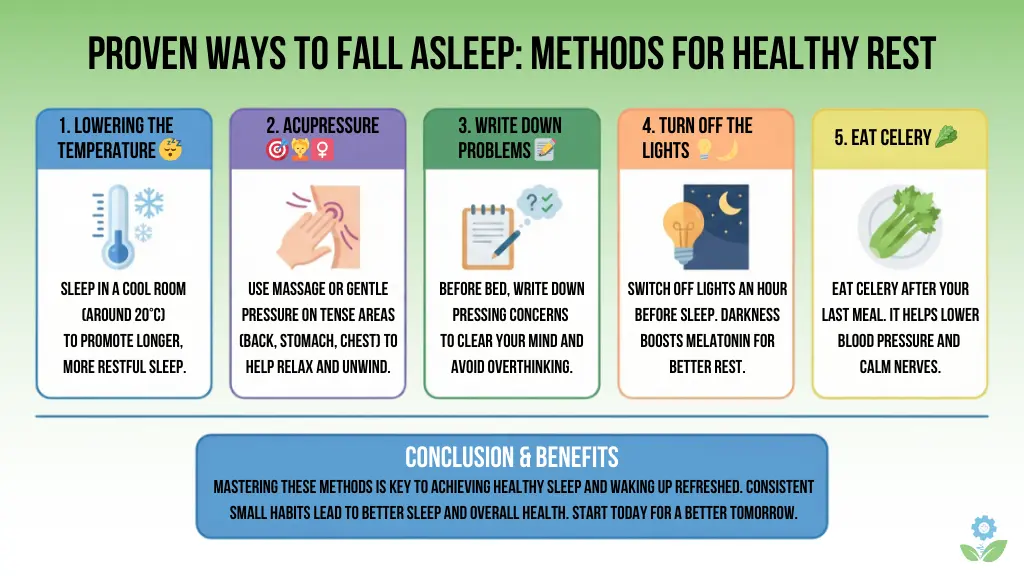
Mastering ways to fall asleep is key to achieving healthy sleep and waking up refreshed.
Simply by incorporating small habits such as lowering the room temperature, doing acupressure, or eating celery, you can figure out how to get a natural healthy sleep. Being consistent with these ways will not only make your sleep better but also your total health—why not starting today for a better tomorrow?
Remember that consistency is the most important element of sleep hygiene. Creating a clear, unchanging pre-sleep ritual signals to your body the need to prepare for rest, which significantly increases the effectiveness of all listed methods.
Try Our Sleep Quality Analyzer Tool
To support your journey in how to get healthy sleep, try our Sleep Quality Analyzer. This tool will conduct a comprehensive assessment of your sleep and provide tips on how to improve it.
References
- Why Is Sleep Important? National Institutes of Health (NIH). [URL: https://www.nhlbi.nih.gov/health/sleep/why-sleep-important]
- Sleep and thermoregulation. EC Harding, C. J. O. (2020 ). PMC – PubMed Central. [URL: https://pmc.ncbi.nlm.nih.gov/articles/PMC7323637/]
- The Temperature Dependence of Sleep. EC Harding, et al. (2019 ). Frontiers in Neuroscience. [URL: https://pubmed.ncbi.nlm.nih.gov/31105512/]
- Thermoregulation in wakefulness and sleep in humans. V Bach, et al. (2011 ). Handbook of Clinical Neurology. [URL: https://www.sciencedirect.com/science/chapter/handbook/abs/pii/B9780444520067000149]
- Effectiveness of Acupressure on Sleep Quality Among Inpatients: A Systematic Review and Meta‐Analysis. W Ling, et al. (2025 ). PMC – PubMed Central. [URL: https://pmc.ncbi.nlm.nih.gov/articles/PMC11884929/]
- Acupressure effect on sleep quality: a systematic review and meta-analysis. Y Lu, et al. (2016 ). International Journal of Nursing Studies. [URL: https://www.sciencedirect.com/science/article/abs/pii/S1087079216301605]
- How Journaling Can Help You Sleep. Psychology Today. [URL: https://www.psychologytoday.com/us/blog/sleep-newzzz/202106/how-journaling-can-help-you-sleep]
- The Effects of Bedtime Writing on Difficulty Falling Asleep: A Polysomnographic Study Comparing To-Do Lists and Completed Activity Lists. MK Scullin, et al. (2017 ). Journal of Experimental Psychology: General. [URL: https://pmc.ncbi.nlm.nih.gov/articles/PMC5758411/]
- Light & Sleep: Effects on Sleep Quality. Sleep Foundation. [URL: https://www.sleepfoundation.org/bedroom-environment/light-and-sleep]
- The influence of blue light on sleep, performance and well-being in young adults: A systematic review. MI Silvani, et al. (2022 ). PMC – PubMed Central. [URL: https://pubmed.ncbi.nlm.nih.gov/36051910/]
- Blue light from light-emitting diodes elicits a dose-dependent suppression of melatonin in humans. KE West, et al. (2011 ). Journal of Applied Physiology. [URL: https://pubmed.ncbi.nlm.nih.gov/21164152/]
- Blue light has a dark side. Harvard Health Publishing. [URL: https://www.health.harvard.edu/staying-healthy/blue-light-has-a-dark-side]
- Exploring New Natural Sleep Supplements: What’s Trending in 2025? Sleep and Narcolepsy. [URL: https://sleepandnarcolepsy.com/my-blogs-and-newsletter/f/exploring-new-natural-sleep-supplements-what%E2%80%99s-trending-in-2025]
- Apigenin: a natural molecule at the intersection of sleep and aging. DJ Kramer, et al. (2024 ). Frontiers in Nutrition. [URL: https://www.frontiersin.org/journals/nutrition/articles/10.3389/fnut.2024.1359176/full]
- Beneficial effects of celery seed extract (Apium graveolens ), as a supplement, on anxiety and depression in hypertensive patients: a randomized clinical trial. M Shayani Rad, et al. (2023). Inflammopharmacology. [URL: https://pubmed.ncbi.nlm.nih.gov/36334223/]
- Antihypertensive Property of Celery: A Narrative Review on Current Knowledge. S Alobaidi, et al. (2024 ). PMC – PubMed Central. [URL: https://pubmed.ncbi.nlm.nih.gov/38505582/]


