

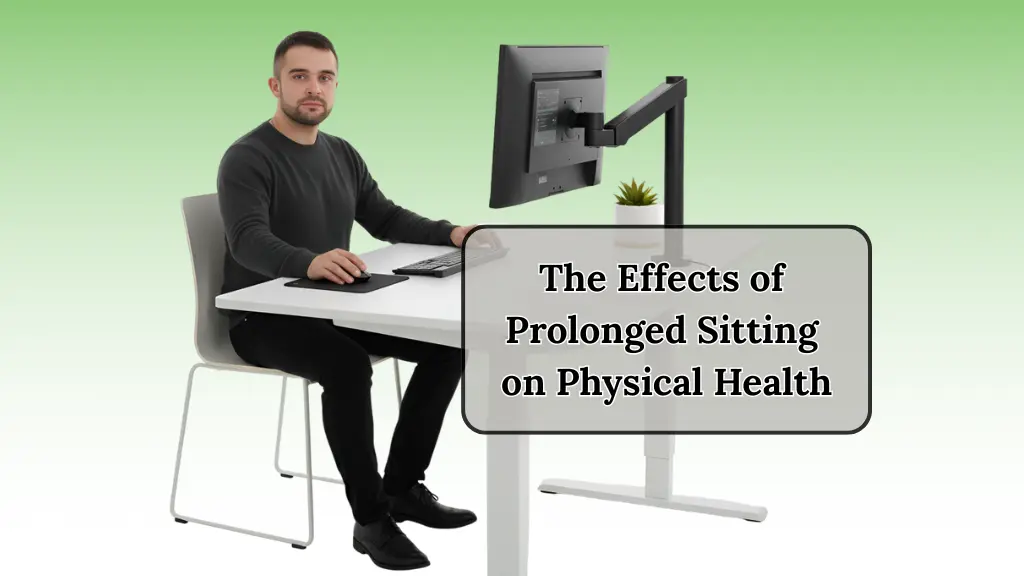
The Effects of Prolonged Sitting on Physical Health
It is unlikely we could find a place in our lives where we wouldn’t sit or intrude on the tradition of sitting. Withstanding prolonged sitting has surely become our typical way, most of us probably I should say, and later its consequences are waiting to come, like a wolf in the wood. This entry will…
It is unlikely we could find a place in our lives where we wouldn’t sit or intrude on the tradition of sitting. Withstanding prolonged sitting has surely become our typical way, most of us probably I should say, and later its consequences are waiting to come, like a wolf in the wood. This entry will uncover the effects of prolonged sitting on our bodies and give the corresponding precaution measures.
Long periods of sitting are a significant issue in public health. The condition is typically known as “sitting disease” [1]. Such inactivity is a risk factor that stands on its own for chronic diseases. The harm is still there for people who do some exercise regularly [1].
INFORMATIONAL NOTE:
This content is for informational and motivational purposes only. Before making significant changes to your diet, exercise routine, or lifestyle, please consult with a qualified professional (such as a doctor, nutritionist, or trainer).
The Physical Impact of Prolonged Sitting
Our health can be hardly said to benefit from prolonged sitting. From a biomechanical viewpoint this is the most static body position which among other things leads to harmful overloading of discs in the lumbar spine, and later to an increased probability of lower back ache. This type of anchor posture also strongly influences the deterioration of the musculoskeletal system in the upper part of the body that subsequently ends up in the pain of the neck and shoulder muscles.
Besides that, the gluteal muscles which are thought of as the most important muscles for body stabilization when sitting become weak without perhaps even noticing delicate the shrinking of these muscles will occur thus provoking tightening to your hamstring muscles. To make matters worse, the blue light produced by computer monitors can damage our eyes and cause diseases such as macular degeneration and cataracts. Consequently, the potential risk for the heart and general body condition induced by the electromagnetic fields (EMF) from the gadgets is also worth being taken into consideration.
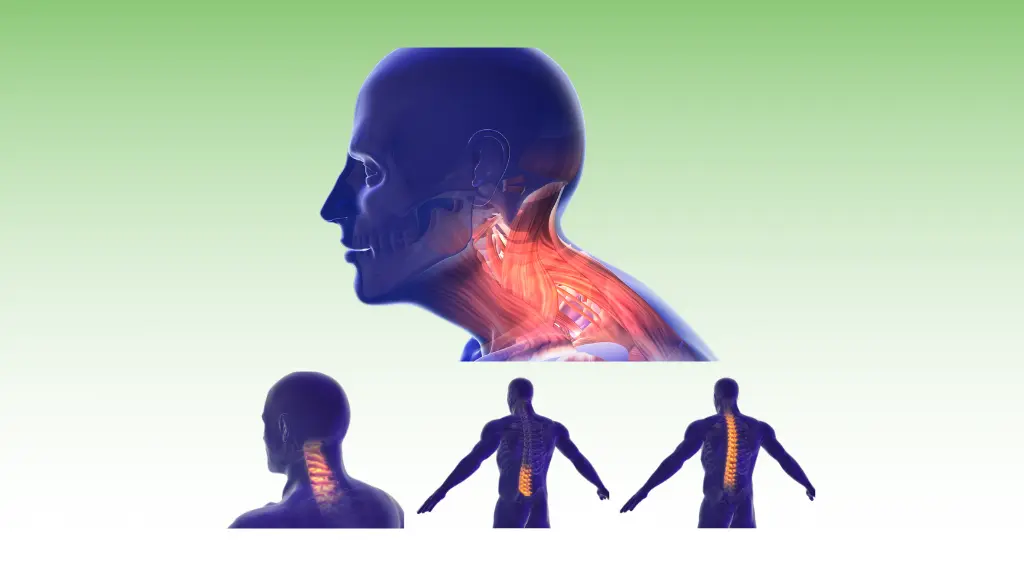
Sitting makes the lumbar spine discs work harder. It forces the lower back with up to 90% more pressure than when a person is standing [2]. The pressure that is kept for a long time is one of the main reasons for chronic lower back pain. Besides that, it can also speed up the process of disc degeneration [2]. From the point of view of metabolism, long sitting dramatically lowers the activity of lipoprotein lipase (LPL) [3]. LPL is an enzyme that is vital for the process of breaking down fats. Its decrease interferes lipid metabolism and raises the risk of cardiovascular problems [3].
The statement that blue light causes macular degeneration is mostly unproven. Nevertheless, blue light may cause eye strain and sleep disruption [4]. The probable danger from EMF (Electromagnetic Fields) emitted by commonly used gadgets is very small. There is no definite scientific proof that links it to heart diseases [5].
Combatting Prolonged Sitting
There exist strategies that can be implemented in order to alleviate the undesirable impacts of prolonged sitting one by one such as:
Frequent Breaks
Without doubt it is necessary to perform frequent breaks during the whole day especially if it is standing up and walking around for three or five minutes every hour. This method alone makes possible to a large extent the prevention of the adverse effects of prolonged sitting. Today almost every person has a smartphone platform where the various battery and reminder apps are downloadable which, among other ways for break-taking, will notify you when to stop sitting for a while.
It is very important to break up periods of sitting regularly with a move. Metabolic health can be improved by such breaks even if they are short and of light intensity [6]. The walk of 3-5 minutes every hour is sufficient to restart LPL. In this way, postprandial glucose and lipid metabolism are getting better [6].
Stretching and Exercises
It would be better for people as well for them to take part in practicing regular stretches and exercises in order to lessen the negative effects of prolonged sitting. They can stretch their shoulders, back, and neck to improve posture and relieve pain.
On top of that, by adding exercises such as squats or push-ups to their breaks they can quickly energize their body with some physical activity.
Targeted stretching is one of the methods that can help basically reverse muscle imbalances. Concentrate your efforts on the stretch of the hip flexors and hamstrings since they are muscles that get tightened as a result of sitting for a long time [7]. Adding to that, exercises for strengthening like glute bridges and planks are effective in returning the body to a state of core stability. This supports the spine and improves posture [7].
Incorporate Movement
It is very necessary to move around during the day instead of being in a fixed position. Shifting positions frequently, using an adjustable chair that allows for movement, or even dancing for a few minutes during breaks are some ways in which you can incorporate movement. The benefit of this is that your physical fitness and your ability to adapt to the environment will be improved as a result of not leading a sedentary lifestyle.
Non-Exercise Activity Thermogenesis (NEAT) plays a crucial role. It is basically the energy that is used for doing things that are not sleeping, eating, or some kind of sports-like exercise [8]. By raising NEAT, for instance, by fidgeting or standing, one can markedly increase total daily energy expenditure. This is very helpful in reducing the metabolic risks associated with prolonged sitting.
Hobbies and Activities
One of the most effective ways to counter the effects of sitting for a long time is to be involved in hobbies or activities that require movement. In the case of yoga or Pilates, these exercises can help you to have a good posture and to be more flexible. Remembering the games and activities of your childhood, such as swinging on swings or climbing on monkey bars, can give you the idea of creative ways which you can use to make your movement routine more fun.
Structured exercise does not fully negate the risks of prolonged sitting. You must reduce total sitting time [1]. Such hobbies as those that require standing or movement are great ways. They, in their nature, lessen the time that is spent in a sedentary state.
Environmental Considerations
Changes that you make in your environment can also help you to get less affected by prolonged sitting. If you wear protective glasses or use screen filters, it will help you to block blue light from computer screens, and as a result, your eyes will be less tired. Then again, the investment in a lamp that gives out full-spectrum light can be more beneficial to the lighting environment as it is more natural. This can serve as a remedy for eye fatigue as well as a booster for general well-being.
While blue light is not proven to cause macular degeneration, it can suppress melatonin production [4]. Using blue light filters in the evening can improve sleep quality. This is a crucial component of overall health.
Monitor EMF Exposure
Electromagnetic fields (EMF) are measurable through the use of specialized gadgets. Trying to identify the amount of your exposure to EMF can lead you to find the strongest sources, and from there, you can decide which steps to take in order to lessen your contact. Lessening the impact of EMF on you can be done by moving electronic equipment, such as computers and power sources, that emits EMF further away from your body. The usage of speakerphone or headphones rather than holding a phone to your ear can also be a way in which exposure is reduced.
According to science, the emission of electromagnetic fields from normal gadgets is non-ionizing. Thus no major health risk is attached to it [5]. It is more efficient to put your energy into known hazards such as inactivity rather than being worried about EMF. Put the emphasis on physical activity rather than on the reduction of EMF.
Ergonomic Support
If you have an office chair or work desk that is probably the most comfortable and restful for you, i.e., ergonomic, the concept of investing in such furniture can do a lot to transform your prolonged sitting experience. Effectively, getting right a chair that you can use in a variety of movements and at the same time back up yourself with the necessary support is what really counts there.
The idea of adjustable height standing desks is catching on fast, so that you can choose whether you carry out your task while standing or sitting without any inconvenience. Equally, use of brace supports or backrest cushions that come in helpful in keeping the right posture is also a way to go.
Ergonomics is the science of designing the workplace to suit the employee. This is the main thing that keeps should be musculoskeletal disorders, from being induced [9]. A height-adjustable standing desk is the best choice. So, one can simply change the position from sitting to standing.
Conclusion
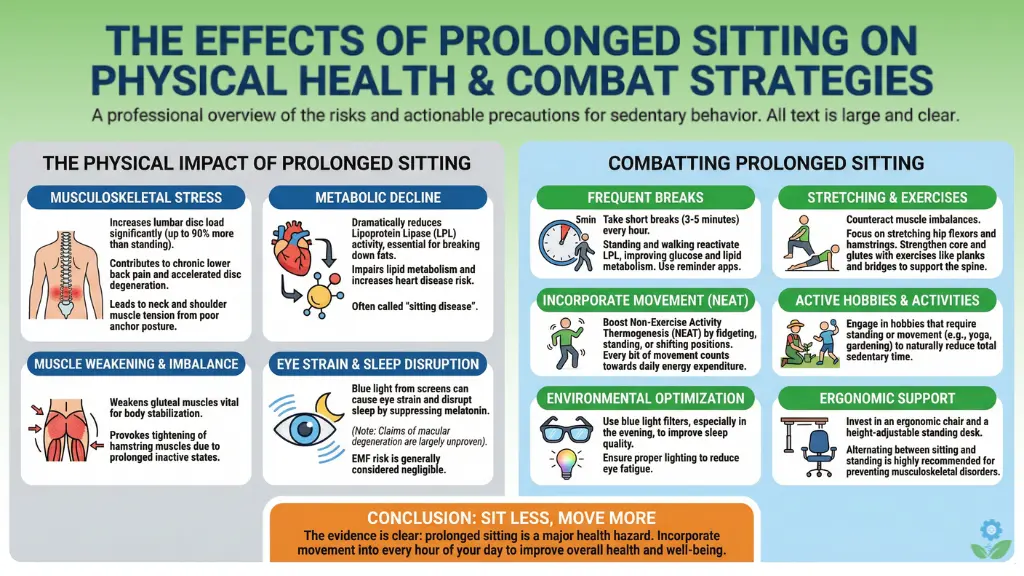
To sum up, the impacts of extended sitting on our bodily health are quite major. Nonetheless, through the inclusion of regular intervals, participation in stretching activities, and performing changes in the environment, we are able to alleviate the harm. If we keep a physically active lifestyle and take care of ourselves, we not only raise our general health but also become less susceptible to stress and our physical condition gets better. Let me remind you that human beings were made for movement and if we follow this rule then we are going to live healthier and happier lives.
If the question arises what is the culprit behind the worst health-related issues, the answer would be certainly sitting. One of the major causes is it holds the potential risk for all sorts of cardiovascular diseases [1][3]. The way out is a straightforward one: cut down on the time sitting and increase the time spent on moving. Find ways to move around in every hour of your day.
Even more useful information for your health — read it here!
References
- Sedentary Behavior and Cardiovascular Morbidity and Mortality. D. R. Young, et al. (2016). Circulation. [URL: https://www.ahajournals.org/doi/10.1161/cir.0000000000000440]
- Don’t take back pain sitting down. Harvard Health Publishing. (2023 ). [URL: https://www.health.harvard.edu/pain/dont-take-back-pain-sitting-down]
- Sedentary Lifestyle: Overview of Updated Evidence of Potential Health Risks. J. H. Park, et al. (2020 ). Korean Journal of Family Medicine. [URL: https://pmc.ncbi.nlm.nih.gov/articles/PMC7700832/]
- Low-energy light bulbs, computers, tablets and the blue light hazard. O’Hagan, J. B., Khazova, M., & Price, L. L. A. (2016). [URL: https://www.nature.com/articles/eye2015261]
- Electromagnetic fields and public health: mobile phones. World Health Organization (WHO ). (2014). [URL: https://www.who.int/teams/environment-climate-change-and-health/radiation-and-health/non-ionizing/emf]
- Breaking prolonged sitting reduces postprandial glycemia in healthy, normal‑weight adults. Meredith C. Peddie (2013). American Journal of Clinical Nutrition (AJCN). [URL: https://www.sciencedirect.com/science/article/pii/S0002916523051821]
- Ergonomic and Proper Posture for Sitting. UCLA Health. (2024 ). [URL: https://www.uclahealth.org/medical-services/spine/patient-resources/ergonomics-prolonged-sitting]
- Non-exercise activity thermogenesis (NEAT ): a component of total daily energy expenditure. J. A. Levine. (2002). The American Journal of Clinical Nutrition. [URL: https://academic.oup.com/nutritionreviews/article-abstract/62/suppl_2/S82/1812445?redirectedFrom=fulltext]
- Ergonomics. Occupational Safety and Health Administration (OSHA ). [URL: https://www.osha.gov/ergonomics]


