


Foods Rich in Zinc: Top Choices for Optimal Health
Zinc is an essential mineral that is the core element of numerous body functions. The metal is required for the defense system but also for the skin to mend after a wound. To put it simply, zinc is one of the primary requirements of a person’s health and general condition. These are the 9 best…
Zinc is an essential mineral that is the core element of numerous body functions. The metal is required for the defense system but also for the skin to mend after a wound. To put it simply, zinc is one of the primary requirements of a person’s health and general condition. These are the 9 best foods rich in zinc that can provide you with enough zinc to fulfill your daily needs.
Zinc is an essential trace element that is part of more than 300 enzymatic reactions in the human body. It has major functions in the immune system, tissue repair, DNA production, and protein metabolism [1]. The RDA (Recommended Dietary Allowance) for zinc is 11 mg a day for adult males and 8 mg a day for adult females [1].
INFORMATIONAL NOTE:
This content is for informational and motivational purposes only. Before making significant changes to your diet, exercise routine, or lifestyle, please consult with a qualified professional (such as a doctor, nutritionist, or trainer).
Foods Rich in Zinc: Turkey Leg 🍗
One of the tasty and healthy meats is a turkey leg which is also rich in zinc. The turkey leg is an ideal zinc source having almost 4.5 milligrams of zinc per 100 grams and thus, can provide you with 37% of the RDI (Recommended Daily Intake) of zinc. In case you are willing to supply your diet with this food rich in zinc, you need to consider baking or roasting it.
For example zinc sources like a turkey, beef, and other meats, which are of animal origin, are generally thought to have higher bioavailability than plant-based ones [2]. The reason is that phytates, which are compounds found in plants that bind to zinc and inhibit its absorption, are not present in animal products [2].
Dutch Cheese 🧀
What comes as a big surprise to many is that Dutch cheese, more specifically the 45% fat variety, can be considered not only a good source of zinc but also a tempting treat. Dutch cheese contains 5 milligrams of zinc per 100 grams thus rendering it a provider of 42% of the RDI of zinc. Though, due to high fat and sodium levels, it is better to take it in limited amounts.
Dairy, like cheese, are excellent zinc sources and the zinc is very bioavailable because some amino acids are present and phytates are absent [3]. But, as it has been pointed out, one should not consume more than the necessary amount because of the saturated fat and sodium, mainly if a person is taking care of his/her cardiovascular health.
Agar Seaweed 🌿🌊
Agar seaweed is a product made from red and brown seaweed and it is a very interesting food as it has more than 5 milligrams of zinc per 100 grams. The problem might be that one cannot eat a large portion of agar seaweed, however, a few tablespoons would be just right. In addition to zinc, agar seaweed is loaded with magnesium, iron, and vitamin B9.
Seaweeds are very rich in nutrients, but the amount of zinc can change a lot and the bioavailability is usually quite low because phytic acid and other inhibitors [2] are present. Apart from that, agar is mostly utilized for its gelling properties and generally, it is not eaten in such amounts that would make it a significant source of zinc.
Kamchatka Crab 🦀
Kamchatka crab is not only an elegant food but also a rich source of zinc. Zinc close to 6 milligrams per 100 grams makes Kamchatka crab a 50% RDI zinc provider. Besides that, the crab meat is rich in copper and selenium which makes it an ideal food for the reproductive system [1]. Crab and lobster, which are types of shellfish, are very good sources of zinc. Most of the time, one serving alone can provide a substantial part of the RDA. The mixture of zinc and selenium is very healthy because these two minerals are the main components of the body’s antioxidant system and they also help the reproductive and immune systems to stay healthy.
Pumpkin Seeds 🎃
Pumpkin seeds are loaded with good nutrients, and to boot, they are high in zinc. Almost 8 mg of zinc per 100 grams are contained in pumpkin seeds, so they can be a very good source of this important mineral for you. But, you should be aware that pumpkin seeds are also high in fat, thus you should eat them in reasonable quantities.
Pumpkin seeds rank among the top plant-based contributors of zinc, however, their zinc content is mostly given for a dry weight basis (per 100g) [4]. If you want to get the most zinc out of pumpkin seeds and other legumes/seeds, you should soak, sprout, or ferment them, turning to these processes as they lower the phytate content [4].
Dried Kelp 🌾
Dried kelp or laminaria is a nutrient-dense superfood and a food rich in zinc. In fact, dried kelp contains more than 9 grams of zinc per 100 grams and therefore, it can be a primary source of this essential element. Nevertheless, this seaweed is extremely high in iodine; hence, it is very important that you limit your portions of dried kelp so as not to exceed iodine intake.
The claim that dried kelp has “more than 9 grams of zinc per 100 grams” is off by a huge margin and the correct value should be “9 milligrams” (mg) [1]. More importantly, kelp is a very highly concentrated source of iodine, and some types can have as much as 2,000 times the upper limit of a serving [5]. If you get too much iodine, your thyroid may not work properly, and you can even get hyperthyroidism or hypothyroidism [5]. So, people should not eat a lot of dried kelp, and they should never use it as a main zinc source because they run a high risk of iodine poisoning.
Hemp Seeds ⚪🌾
Sesame seeds are small nutrient-rich nuggets, and to boot, they are a good source of zinc. Zinc content in the sesame seeds is more than 10 grams per 100 grams, so these seeds can be your daily zinc intake facilitators. Nevertheless, it is recommended to use sesame seeds in small portions due to their high fat content.
The text is a misnomer when it talks about “Hemp Seeds” in the title but goes on to describe “Sesame Seeds” in the body, and it also mixes up the zinc content by stating it as “10 grams” instead of “10 milligrams” (mg) for the second time [1]. Sesame seeds are indeed a good source of zinc (approx. 7-10 mg per 100g), however, like all seeds, phytates limit the zinc bioavailability in them [4]. On the other hand, hemp seeds are also a great source, offering around 10 mg of zinc per 100g, and are packed with the healthy Omega-3 and Omega-6 fatty acids.
Oyster 🦪
Oysters have not only been a popular choice for their aphrodisiac properties but also as one of the top foods rich in zinc. Oysters contain almost 17 grams of zinc per 100 grams, making them the most powerful zinc source. The intake of zinc, copper, and selenium can be satisfied by just one large or two medium-sized oysters. The condition is that it must be your diet. But first, availability, quality, and taste of oysters should be figured out.
Oysters are, without a doubt, the single richest food source of zinc, with some varieties providing over 60 mg per 100g, which is several times the RDA [1]. Correction: The zinc content is approximately 17-60 milligrams (mg) per 100 grams, not “grams” [1]. Because of this incredibly concentrated amount, a mere handful of oysters are sufficient to fulfill or even go beyond the daily requirement, thus, they become a perfect supply of zinc to fix a deficiency.
Conclusion
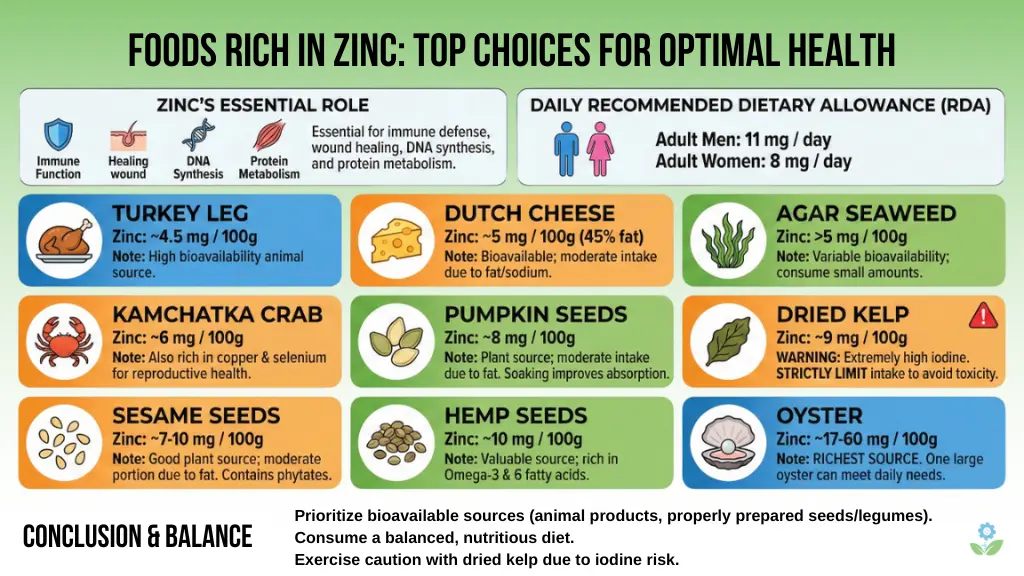
Zinc is one of the major contributors to human health. Consuming foods rich in zinc including turkey leg, Dutch cheese, agar seaweed, Kamchatka crab, pumpkin seeds, dried kelp, hemp seeds, sesame seeds, and oysters would be the best way to provide your body with the adequate amount of zinc that it needs daily. Eating these foods in moderation and being conscious of your overall dietary needs which is a balanced and nutritious diet should not be forgotten.
By means of bioavailable sources (animal products and properly prepared legumes/seeds) people have to ensure optimal zinc status and at the same time, they should be aware of the inhibitors like phytates [2]. Warning: Because of the possibility of iodine poisoning, dried kelp is to be eaten only in very little, controlled amounts, and should not be used as a zinc source [5].
Try Our Food Calorie Calculator
To ensure you’re meeting your nutritional needs with foods rich in zinc, try our Food Calorie Calculator tool. Visit our AI Health Tools category for more AI-powered tools to support your mental and physical health!
References
- Zinc – Health Professional Fact Sheet. Office of Dietary Supplements (ODS), National Institutes of Health (NIH). [URL: https://ods.od.nih.gov/factsheets/Zinc-HealthProfessional/]
- Bioavailability of iron, zinc, and other trace minerals from vegetarian diets. J. R. Hunt. (2003 ). The American Journal of Clinical Nutrition. [URL: https://pubmed.ncbi.nlm.nih.gov/12936958/]
- Zinc: an essential micronutrient. R. B. Saper, et al. (2009 ). The American Journal of Clinical Nutrition. [URL: https://pmc.ncbi.nlm.nih.gov/articles/PMC2820120/]
- [Zinc Concentrations and Forms in Plants for Humans and Animals. R. M. Welch, et al. (2008 ). In: Zinc in Soils and Plants. [URL: https://scispace.com/papers/zinc-concentrations-and-forms-in-plants-for-humans-and-2bb8fso729]
- Commercially available kelp and seaweed products–valuable iodine source or risk of excess intake? I. Aakre, et al. (2021 ). Food & Nutrition Research. [URL: https://pmc.ncbi.nlm.nih.gov/articles/PMC8035890/]


