


Benefits of Exercise: Why It’s Essential for Your Health
Without a doubt, physical activity is the mainstay of good health. We talk about the benefits of exercise and how it influences our health in this blog. We discuss the importance of working out regularly, the influence on our cells and DNA, and the part of exercise in resolving health issues. After reading this blog,…
Without a doubt, physical activity is the mainstay of good health. We talk about the benefits of exercise and how it influences our health in this blog. We discuss the importance of working out regularly, the influence on our cells and DNA, and the part of exercise in resolving health issues. After reading this blog, you will want to start exercising every day.
The World Health Organization (WHO) acknowledges that frequent physical activities are among the major contributors to good health, as it is supported by various studies that it can be a deterrent and a remedy of non-communicable diseases like cardiovascular diseases, stroke, diabetes, and some cancers [1].
INFORMATIONAL NOTE:
This content is for informational and motivational purposes only. Before making significant changes to your diet, exercise routine, or lifestyle, please consult with a qualified professional (such as a doctor, nutritionist, or trainer).
Benefits of Exercise: Avoiding the Risks of Sedentary Life 🏃♂️💪
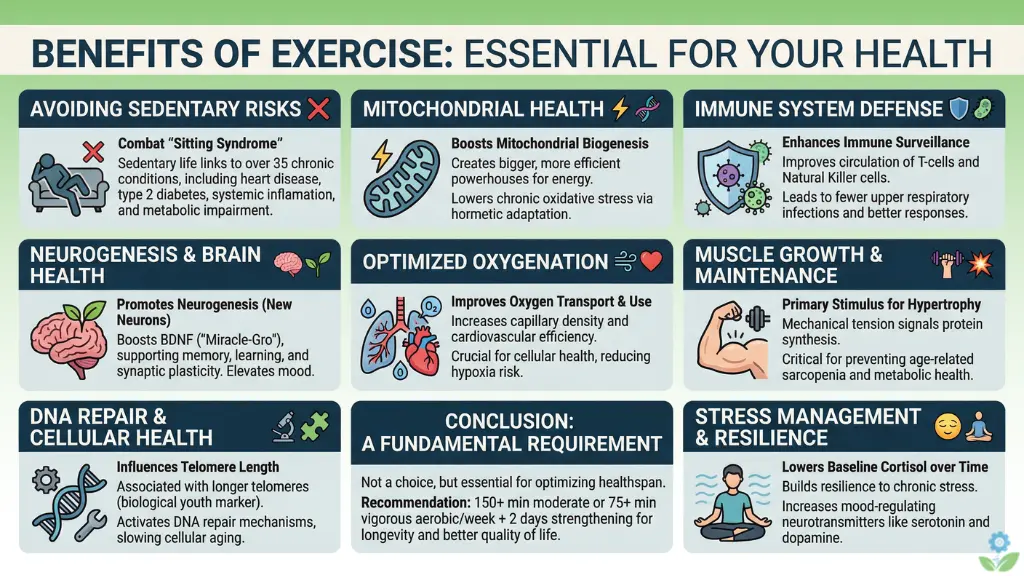
Leading a sedentary life is likewise referred to as sitting syndrome or couch potato syndrome and it may bring very bad consequences both physically and mentally. The main cause of over 35 chronic health conditions which include atrophy of muscles, metabolic syndrome, hyperglycemia, hypercholesterolemia, hypertension, obesity, insulin resistance, diabetes, fatty liver, cancer, stroke, dementia, mood disorders, bone diseases, digestive disorders, and even reproductive dysfunctions has been identified as lack of physical activity.
The CDC states that physical inactivity is associated with an increased risk of many chronic diseases and raises the risk of early death by 20-30% [2]. The main reason is that a sedentary lifestyle causes systemic inflammation, weakens metabolic function, and results in the slow deterioration of musculoskeletal and cardiovascular systems.
Exercise Makes Your Mitochondria Healthier ⚡🧬
The mitochondria are the powerhouses of the cell and they are the main source of energy. They are also the root of cancer, and the benefits of exercise increase mitochondrial biogenesis that result in bigger and more powerful mitochondria.
Exercise, by increasing energy production through oxygen delivery to the mitochondria, has a repercussion of lowering oxidative stress. In general, oxidative stress is a source of damage, but here it acts as a factor that strengthens the mitochondria thus allowing them to produce more antioxidants that will neutralize the stress. The interplay of exercise and health, especially mitochondrial function, is one of the major factors determining human health.
Physical activity is the strongest measure known that can induce mitochondrial biogenesis the generation of new, more efficient mitochondria [3]. The eventual increase in the ability of muscles to use oxygen for aerobic respiration, thus improving energy production and limiting metabolic dysfunction, is the key adaptation, especially after endurance and high-intensity interval training (HIIT) [3]. Although exercise increases oxidative stress in the short term, this utilization of a hormetic signal ultimately results in the mitochondria elevating their own very strong antioxidant defense systems, thereby lowering chronic oxidative stress overall [4].
Exercise and the Immune System 🛡️🦠

The habitual practice of different kinds of sports and putting our bodies in activity leads to both our innate and acquired immune system being at their peak performance, which results in antibody levels becoming higher, and immune cells not only increasing in number but also becoming more potent.
As a consequence, the infection process will be aborted more promptly, and the incidence of upper respiratory tract infections will be minimized. People will also be less likely to suffer from heart diseases, arrhythmias, coronary artery dysfunction, stroke, dementia, affective disorders, bone diseases, and immune deficiencies through this way.
Regular, moderate-intensity exercise enhances immune surveillance by improving the circulation of immune cells, such as T-cells and Natural Killer (NK) cells, allowing them to detect and eliminate pathogens more effectively [5]. Nevertheless, it should be emphasized that excessive, long, and strenuous exercise without sufficient recovery may lead to immune suppression and thus the immune system will be less effective for a short time.
Exercise and Neurogenesis 🧠🌱
Physical activity by increasing blood supply causes neurogenesis not only in the brain but also in other parts of the nervous system. One of its effects is the enhancement of memory and the alleviation of symptoms of dementia. Moreover, by decreasing the level of depression, anxiety, and post-traumatic stress disorder, exercise indirectly elevates the general emotional state of an individual. People who regularly perform physical exercises usually have good psychological health. The amount and the degree of exertion of physical activity have a direct impact on one’s emotional state. Depressed people are usually inactive, and those who have a lot of energy are hardly ever sitting down.
Physical activity is an essential factor for neurogenesis (the formation of new neurons) in a major part, the hippocampus, the brain area associated with learning and memory [6]. The influence of this is to an extent mediated by one protein called Brain-Derived Neurotrophic Factor (BDNF) which is known as “Miracle-Gro for the brain” most of the time. In fact, exercise is one of the main reasons why BDNF levels are elevated all the time. Higher BDNF supports neuronal survival, growth, and synaptic plasticity, thus leading to better cognitive function and mood [6].
Exercise and Oxygenation 🌬️❤️
Oxygen content in body organs is a very important factor for human health.
Hypoxia, an oxygen deficit, may lead to a variety of health problems. The people who exercise frequently are the ones who can supply all of their organs with oxygen, and this lively exchange will go effortlessly, and the organs will be able to acclimatize to new environments. Consequently, the risk of having chronic diseases is decreased. Besides the benefits of building muscle through the gym, the physical activity advantages are blood sugar regulation, better insulin sensitivity, and insulin resistance alleviation. Essentially, the effort revives the arteries that are in danger of atherosclerosis, and it is also instrumental in increasing joint movement, tendon flexibility, and muscle strength.
Basically, when you keep doing some normal cardio exercises your body gets better in its blood transportation and oxygen utilization as the number of blood vessels in muscles increases, more red blood cells are produced and heart and blood vessels become more efficient [1]. Oxygen plays a vital role in keeping the cells alive and with such a supply, the chances of tissue damage due to lack of oxygen are lowered considerably all over the body.
Exercise and Muscle Growth 🏋️♀️💥
Muscle growth is solely dependent on exercise. Nutrition and amino acids are not to be overlooked, as they are necessary for muscle development, but they only serve as the basis. Muscle growth is fundamentally one to which the muscle tension of the organ is exercised is the primary subject, so exercise is the main culprit. Besides that, exercise is very helpful in the prevention of muscle wasting and atrophy, as the elderly who lose their muscles more rapidly will be better off with it. You can keep and develop your muscle mass by exercising regularly.
Resistance training is the primary stimulus for muscle hypertrophy (growth) by creating mechanical tension that signals muscle protein synthesis [7]. Nutrition basically gives the building blocks (amino acids), but exercise is definitely the non-negotiable activator. Keeping muscle mass is very important for metabolic health since muscle is the main place where glucose is being used and it also has a very important role in co-preventing age-related sarcopenia and frailty.
Exercise and DNA Repair 🔬🧩
During the times of evolution, our bodies had to go through a lot of heavy physical work and stress. Our ancestors had to chase the animals to eat, run from the predators, and do other physically hard things. DNA repair processes are set off by the benefits of exercise, which makes the body fit for the new situation and thus can live on.
Continuous exercising turns on the survival mechanisms that increase the ability to repair DNA damage and at the same time, it switches off the mechanisms that make survival difficult. Exercising people are equipped with a better DNA and cell repair system, which is very much consistent with the general idea of staying longer and healthier.
Physical activity has been shown to influence the length of telomeres, the protective caps at the ends of our chromosomes that shorten with each cell division [8]. Several systematic reviews indicate that regular and enduring aerobic exercise is linked to greater telomere length, a marker of biological youth and cellular health [8]. Physical activity seems to boost the level of telomerase, the enzyme that keeps the telomere length, thus it is one of the ways that the aging of the cell is delayed.
Exercise and Stress Management 😌🧘♂️
Stress is a very common factor in our nowadays rapidly moving life, and it is also very closely related to chronic diseases. We can fight better against stress if we take up regular exercising as it builds our energy reserves.
By means of the same work, the reduction of cortisol level can take place. The practice can also bring cortisol down, the stress hormone, particularly in aerobic activities like walking or hiking. However, the cortisol increase takes place only at the very beginning of the intense period of work, and it is already lowered in the recovery phase, hence the stress is alleviated of. The time for recovery from the exercise should also be the time for enjoyment, and this is the reason why it is very important to separate the workout and rest.
During the intense exercise, the level of the stress hormone cortisol is elevated, however habitual physical activity is associated with a lower baseline level of cortisol and a reduced cortisol response to the psychological stressors [9]. Such an adjustment imparts the body with a higher degree of tolerance to the less desirable effects of the chronic stress. Besides that, exercise is a very potent anxiolytic (anxiety-reliever) and antidepressant, and that is a part of the reason why it is able to induce the production of the mood-regulating neurotransmitters like serotonin and dopamine.
Conclusion
Physical activity must not be seen as a choice or a thing that can be put aside until later; it’s actually a very important factor to maintain good health.
The positive side of the physical activity are to the large they biological system, for instance improved mitochondrial function, a more robust immune system, neurogenesis, higher oxygenation, DNA repair, and stress relief. If you incorporate exercise into your daily routine, you will be able to live longer as well as have a better quality of life.
Primary health benefits may be achieved by following the recommendations of the American College of Sports Medicine (ACSM) and the CDC, which include 150 minutes of moderate-intensity aerobic activity or 75 minutes of vigorous-intensity aerobic activity per week. In addition, these guidelines suggest the inclusion of muscle-strengthening activities for at least 2 days per week [2] [7]. Integrating this level of activity is not a choice, but a fundamental requirement for optimizing healthspan and longevity.
Try Our Health & Fitness Tools
Discover the benefits of exercise tailored to your needs with our Health & Fitness Calculator, which calculates BMR, TDEE, BMI, and daily calorie needs, or use our Activity Calorie Calculator to estimate calories burned based on your activity. Visit our Fitness & Body Transformation category for more tips and inspiration to support your journey to a healthier you!
References
- Physical activity. World Health Organization (WHO). [URL: https://www.who.int/news-room/fact-sheets/detail/physical-activity]
- Physical Activity for Adults: The Basics. Centers for Disease Control and Prevention (CDC ). [URL: https://www.cdc.gov/physical-activity-basics/guidelines/adults.html]
- High-Intensity Exercise and Mitochondrial Biogenesis. D. J. Bishop, et al. (2019 ). Physiology. [URL: https://journals.physiology.org/doi/full/10.1152/physiol.00038.2018]
- Oxidative stress: role of physical exercise and antioxidant nutraceuticals in adulthood and aging. C. Simioni, et al. (2018 ). Oxidative Medicine and Cellular Longevity. [URL: https://pmc.ncbi.nlm.nih.gov/articles/PMC5908316/]
- Exercise and the Regulation of Immune Functions. D. C. Nieman & L. M. Wentz. (2019 ). Acute Topics in Sport Nutrition. [URL: https://pubmed.ncbi.nlm.nih.gov/26477922/]
- Exercise promotes the expression of brain derived neurotrophic factor (BDNF ) through the action of the ketone body β-hydroxybutyrate. S. F. Sleiman, et al. (2016). eLife. [URL: https://pmc.ncbi.nlm.nih.gov/articles/PMC4915811/]
- American College of Sports Medicine position stand. Quantity and quality of exercise for developing and maintaining cardiorespiratory, musculoskeletal, and neuromotor fitness in apparently healthy adults: guidance for prescribing exercise. American College of Sports Medicine (ACSM ). (2011). Medicine & Science in Sports & Exercise. [URL: https://journals.lww.com/acsm-msse/fulltext/2011/07000/quantity_and_quality_of_exercise_for_developing.26.aspx%5D]
- Does Exercise Affect Telomere Length? A Systematic Review and Meta-Analysis of Controlled Clinical Trials. S. Song, et al. (2022 ). Journal of Clinical Medicine. [URL: https://pmc.ncbi.nlm.nih.gov/articles/PMC8879766/]
- The effects of exercise intensity on the cortisol response to a subsequent acute psychosocial stressor. [URL: https://www.sciencedirect.com/science/article/pii/S0306453021002109]


