


How to Keep Energy and Emotional Well-being
Have you ever experienced a complete lack of energy? Are your thoughts and emotions often beyond your control? If these are the cases, you need to know that you share this situation with many others. Many of them have the same problem: to keep energy and their emotional well-being. It is very important to keep…
Have you ever experienced a complete lack of energy? Are your thoughts and emotions often beyond your control? If these are the cases, you need to know that you share this situation with many others. Many of them have the same problem: to keep energy and their emotional well-being. It is very important to keep a high level of both physical and psychoemotional energy for the person’s health, productivity, and ability to defy the stress.
This article presents the first part of the problem: the reasons for the loss of energy. We will also talk about strategies to beat such challenges.
INFORMATIONAL NOTE:
This content is for informational and motivational purposes only. Before making significant changes to your diet, exercise routine, or lifestyle, please consult with a qualified professional (such as a doctor, nutritionist, or trainer).
The Impact of Thoughts and Emotions 🧠💭
Consciousness control is one of the main factors that determine the level of our energy. According to recent news, the number of daily thoughts is between 50 and 70 thousand. Nevertheless, only a handful of these thoughts are productive, while the rest can be considered as irrelevant. The endless flow of thoughts, especially if it is a repetitive or negative kind of self-talk, is one of the main factors behind what is called cognitive load. Research in the field shows that long-lasting cognitive load may result in mental exhaustion that, in turn, is accompanied by sympathetic hyperactivity and a decline in cognitive functions that can be recorded [1].
Taking part in an information detox will definitely lessen the emotional load that comes as a result of this “noise”. It’s really all that information that you consume every day that you need? An information detox, which is essentially setting limits on digital consumption, is a feasible approach to lessen the unnecessary cognitive load that takes away mental resources.
A lot of people choose to get already processed information so that they can save both time and energy. By getting rid of the excess you can really save yourself and achieve the outcome you want at the end. By selecting certain sources of information and watching their consumption, people can put their limited brain power to work for the tasks that are in line with their goals.

The Power of Worldview 🌍✨
One of the main points for sustaining your energy and emotional well-being is nevertheless a clear understanding of the world and what role the person has in it. In case you don’t have a clear worldview, then every piece of fresh information that you find might just seem like more stuff to your already cluttered mind. A consistent worldview provides a cognitive framework through which the brain can effectively classify and unite new information, thus it keeps the amount of mental effort needed for processing at a minimum.
It’s like you find a new book and you don’t know which shelf in your room to put it. Without a clearly delineated worldview you will not be able to figure out how to use the new information you have found. This results in mental clutter and energy being wasted. Mental clutter is one of the cognitive inefficiencies that has an indirect impact on the feeling of being overwhelmed and exhausted.
Based on the Dunning-Kruger effect, being even a little bit wrong in your understanding of how things happen may result in that you gain false confidence which is not good for your well-being. It really is better to be a learner and admit that you don’t know than to take actions based on wrong assumptions. The Dunning-Kruger effect is a cognitive bias where individuals with low competence overestimate their abilities. This bias can result in bad decisions followed by failures that, in turn, negatively affect one’s emotional well-being and self-confidence. Developing a growth mindset that is open to learning and recognizes one’s limitations is, however, a better and more durable way of emotional resilience.

The Two Types of Energy 🔥💧
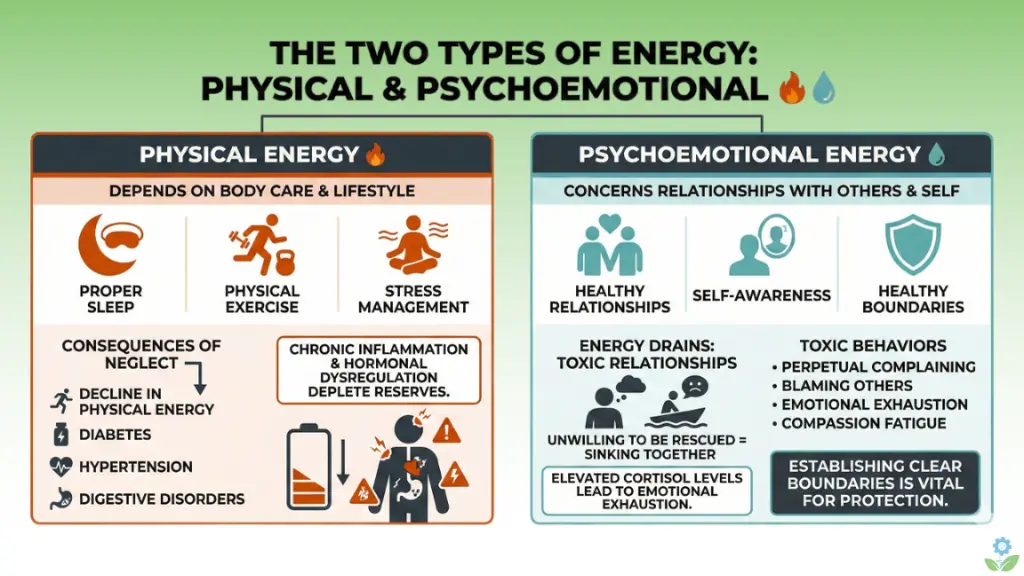
Energy can be divided into two types: physical and psychoemotional.
- Physical energy is the one that depends on how well we take care of our bodies. It is the outcome of such a lifestyle as proper sleep, physical exercise and stress management. Being unable to cope with these challenges will result in the decline of our physical energy and consequently, an increase in these health issues such as diabetes, hypertension, and digestive disorders. The connection between poor lifestyle choices and physical health decline is often mediated by chronic inflammation and hormonal dysregulation, which directly deplete energy reserves.
- Meanwhile psychoemotional energy concerns our relationships with others and ourselves. Among the main factors poisoning the relationships and thus energy drains are toxic ones. Some people seem to be unable or unwilling to rescue themselves, so helping them can be like carrying a person who is drowning while you’re in a boat. If they don’t do their part in the rescue, you will end up sinking with them. Such people are called toxic ones. Those who perpetually complain and blame others for their problems, thus, emotionally exhausting those who surround them.
Unfinished Business ⏳🧩
Every unfinished task or unresolved issue creates a small amount of stress. These undone matters create a pathological reflex circuit in our brains that robs our energy. It’s like having a chain of unresolved problems in our minds. This phenomenon is scientifically described by the “Zeigarnik Effect”, which posits that uncompleted tasks create a cognitive tension that makes them more memorable and intrusive than completed ones [2].
Regaining control of our energy requires us to face these tasks directly. Otherwise, the circuit will keep spinning, continuing to consume our energy and causing anxiety. People can harness the feeling of achievement from finishing a task to revive their mental energy and lessen their anxiety by dividing big, intimidating tasks into smaller, manageable steps.
The Impact of Lies 🤥💔
Dishonesty towards others or ourselves can immensely diminish psychoemotional energy. Lying to ourselves is even more damaging than lying to others. When we cheat ourselves, we drift away from our real goal and do things that are not in line with our values and desires. “Deception effort” is the term used to describe the cognitive work that lies behind maintaining a lie. It is an identifiable reduction in one’s mental capacity since a person has to not only control his or her own actions but also keep track of the reaction of others all the time.
Such unawareness of our behavior drives us far from our goals and, in the end, it is what exhausts us. Being honest with ourselves and doing things that really satisfy us is of utmost importance. Authenticity and alignment between one’s actions and core values are foundational to intrinsic motivation and sustained psychoemotional well-being.
Guilt and Shame 😔⚖️
Feeling guilty or ashamed all the time is another thing which, in a figurative sense, sucks the human body of its energy. The practice of punishing and criticizing oneself may result in long-term stress and the overall state of one’s emotional health may also be compromised. It is important to distinguish between guilt, which is the feeling of remorse over a specific action (“I did a bad thing”), and shame, which is the painful feeling about oneself (“I am a bad person”).
Guilt implies criticism of others, whereas shame is criticism of ourselves. Both of these feelings are frequent reasons for the development of neuroses and can drain psychoemotional energy to a very significant degree.
The Power of Fear 😨⚡
Fear is usually a result of not being certain and not understanding a particular situation. Nevertheless, it is important to question what actual things would happen if what we fear the most did come true. Would we lose our jobs? Would we fail an exam? In most cases, the results are not as bad as we think. When we think through a worst-case scenario, it is often possible to come up with ways of lessening the risks and thus also lessening the fear of it occurring. This technique, known in cognitive behavioral therapy (CBT) as **decatastrophizing**, helps to challenge the exaggerated, catastrophic thoughts that fuel anxiety and fear.
Fear makes a person motionless and, thus, intervention cannot be carried out. What we should not forget, however, is that intervening and, therefore, moving in the direction of our aims, is what actually lengthens our lives. Chronic, unmanaged fear can lead to a state of hypervigilance, which elevates stress hormones like cortisol, further contributing to physical and mental exhaustion [3].
The Pitfalls of Unrealistic Expectations 🌫️
Unrealistic expectations is yet another way through which has the potential to drain our energy. Having a distorted perception of reality leads to setting ourselves up for disappointment. Taking an instance of dreaming of a tropical paradise and, upon your arrival, discovering that it’s raining and much colder than you expected, you will most likely be left with the feeling of unhappiness and dissatisfaction.
The bigger the difference between our expectations and reality, the stronger will be our emotional reaction. It is of utmost importance to have realistic expectations and concentrate on the here and now instead of constructing far-fetched scenarios in our minds.
Conclusion
It is essential for a livable life that people keep energy and emotional well-being. Besides, we can find the professionals like coaches and therapists who will guide us through rough times and teach us the techniques of mastering our emotions. Such a health model considers that the human body, mind, and emotional sphere are still tightly related to each other, and these three constitute the base of any lively and vigorous life.
Keep in mind that life is not long enough to be lived in a stressful condition with a lack of energy. Be the boss of your health and live in bliss and vigor!
You can monitor your mood and emotional well-being with our tool: 🌤️ Mood Tracker.
There is more informative content and inspiration available for you at our Brain & Mental Health category to help you on your way to becoming a healthier version of yourself!
References
- Mizuno, K., Tanaka, M., Fukuda, S., Imai, A., & Watanabe, Y. (2011). Mental fatigue caused by prolonged cognitive load associated with sympathetic hyperactivity. *Behavioral and Brain Functions*, 7(1), 17. [URL: https://pmc.ncbi.nlm.nih.gov/articles/PMC3113724/]
- Psychology Today. Zeigarnik Effect. [URL: https://www.psychologytoday.com/us/basics/zeigarnik-effect]
- Cay, M., et al. (2018). Effect of increase in cortisol level due to stress in healthy individuals. Journal of Clinical and Diagnostic Research, 12(11). [URL: https://pmc.ncbi.nlm.nih.gov/articles/PMC6371989/]


