


Insulin: The Key to Unlocking Muscle Growth 🔑💪
Have you been working hard but still not seeing your muscle mass increase? We’re going to dissect the relation of insulin to muscle growth and reason out why some people don’t get the results they envision. We will probe into the body’s smallest units, the cells, and figure out the cellular level processes involved in…
Have you been working hard but still not seeing your muscle mass increase? We’re going to dissect the relation of insulin to muscle growth and reason out why some people don’t get the results they envision.
We will probe into the body’s smallest units, the cells, and figure out the cellular level processes involved in muscle protein synthesis.
⚠️ IMPORTANT DISCLAIMER:
This information is not intended to be a substitute for professional medical advice, diagnosis, or treatment. The content of this article is for informational purposes only. Always seek the advice of your physician or other qualified health provider with any questions you may have regarding a medical condition. Never disregard professional medical advice or delay in seeking it because of something you have read on this site.
Insulin’s Role in Muscle Growth 💉⚙️
It is insulin that is similar to the key that opens up the muscle cells, ushering in amino acids and turning them into skeletal muscle protein. The lack of insulin results in cells not getting the required amino acids and thus no muscle growth will occur. But understanding insulin resistance is equally important as this condition is typically associated with prediabetes or type 2 diabetes.
Insulin, a hormone produced by the pancreas, is fundamentally an anabolic (building) and anti-catabolic (breakdown-preventing) hormone [1]. In fact, the main function of insulin in muscle growth is not directly to trigger muscle protein synthesis (MPS), but to suppress muscle protein breakdown (MPB) that is vital for a net protein balance of growth to take place – hypertrophy [1]. Insulin is basically a permissive hormone as well in MPS by, among other things, elevating blood flow to the muscle and making the transport of amino acids into the muscle cells easier, particularly if the amino acid concentration is high [2].
Insulin resistance refers to the situation when there is a lot of insulin but its effectiveness is very low. The cells therefore end up not getting the necessary amino acids.
The Misconception of Carbohydrate Intake 🍞❌
People who think that carb loading will increase insulin levels and thus muscle growth are mistaken. Overdoing carbohydrates will result in insulin resistance, which in turn will retard the uptake of amino acids by the cells. The body, on the other hand, only needs a little sugar. The amount is about 100 milligrams of insulin per deciliter of blood or one teaspoon for every five and a half liters of blood.
The interaction of carbohydrates consumption with insulin and muscle growth is complex and the people usually tend to simplify it. Although chronically eating too many calories and living a sedentary lifestyle are the main causes of systemic insulin resistance, the timing and type of carbohydrate intake matter a lot for muscle anabolism to a maximal level [3]. Carbohydrates intake after a workout is a good idea mainly because muscle cells are very insulin-sensitive, and the consequent insulin spike helps to quickly restore muscle glycogen and also supports the anti-catabolic effect [3]. Still, if someone is always raising their insulin levels through a too high consumption of carbohydrates, this could lead to a situation where their insulin receptors become desensitized, thus possibly impairing their metabolic health and nutrient partitioning in the long run.
At the same time, an average person consumes sugar equivalent to 21 teaspoons daily.
Focus on Other Factors 🎯🧠
Increasing insulin levels should not be the only way to achieve muscle growth, and other contributing factors need to be taken into account. One of the most important factors is physical exercise since it can stimulate the production of growth hormone that helps the body in the process of converting amino acids into muscle proteins.
The true “master switch” for muscle protein synthesis is the mTOR (mammalian Target of Rapamycin) signaling pathway, which is primarily activated by the amino acid Leucine and mechanical tension from resistance exercise [4]. Insulin supports this process, but the stimulus from Leucine (found abundantly in high-quality protein sources) is the most potent nutritional trigger for MPS [4].
High-intensity and compound strength training exercises that target the entire body will bring the best results. Besides, rest and recovery are also very important, and therefore, enough sleep should be guaranteed since muscle mass development takes place when the body is at rest. Sleep is a critical, often overlooked, component of muscle growth, as the majority of Growth Hormone (GH) release occurs during deep, slow-wave sleep [5]. Growth hormone is necessary for the repair of tissues, muscle development, and fat breakdown. Therefore, an adequate sleep (7-9 hours) is absolutely necessary if one wants to get the most out of their training [5].

The Importance of Protein Intake 🥩🍳
Protein intake has to be sufficient if one wants to increase muscle mass. On the other hand, too much protein can cause the liver to become overworked and make insulin production increase, which, in turn, may lead to insulin resistance. The best thing to do is to take in proteins from good quality sources only. To illustrate, fish proteins are considered to be of the highest quality. Although whey protein is quite popular, it is worth mentioning that in comparison with other proteins, low-fat whey proteins can elicit a stronger insulin response. If coconut oil is added, this can be offset by the presence of healthy fats.
It is crucial to have the most suitable amount of protein, and at present, the advice for people who do resistance training is 1.6 to 2.2 grams of protein per kilogram of body weight per day [6]. Protein quality is defined by its amino acid profile, especially by its Leucine content, which is the most direct signal for the mTOR pathway [4]. Excess protein intake (over 2.2 g/kg/day) is usually discouraged because it doesn’t bring any extra benefit, however, the body can still be considered very efficient in protein processing, and the “overworking of the liver” explanation is basically not supported by very few studies for healthy people [6]. Whey protein’s significant insulin response is basically due to its quick digestion and high amino acid content, which is usually a good thing after a workout for fast nutrient delivery.
The Sodium-Potassium Pump ⚡🧬
The sodium-potassium pump is one of the mechanisms that allow stripped proteins, vitamins, minerals, and glucose to enter the cells. In order to be activated and work properly, the pump needs to be supplied with sodium as well as potassium. Lack of sodium can cause the process to stop, while potassium deficiency is usually more prevalent.
It actively transports three sodium ions (Na+) out of the cell for every two potassium ions (K+) it pumps in, maintaining the electrochemical gradient necessary for muscle excitability and nutrient transport [7]. By actively moving three sodium ions (Na+) out of the cell and two potassium ions (K+) in, it keeps the electrochemical gradient required for muscle excitability and nutrient transport [7]. If the pump is to function properly, then it is necessary for the muscle recovery and the performance, since it is the one that delivers the potassium that was lost during the vigorous exercise.
Thus, the daily intake of sodium should be about a half of a teaspoon and that of potassium approximately 4700 milligrams. By taking these elements either from food or supplements, the permeability of the cells can be improved and insulin resistance can be corrected. For most adults, the advisable daily intake of potassium is certainly 4,700 mg, and putting enough into the body is very important for keeping the Na+/K+-ATPase function going as well as for the whole cardiovascular system to stay healthy [7]. Keeping the electrolytes in balance is very important for the cells to work properly. However, the direct fixing of systemic insulin resistance is basically done by regular exercise and proper diet, and not just by giving sodium and potassium.
Conclusion
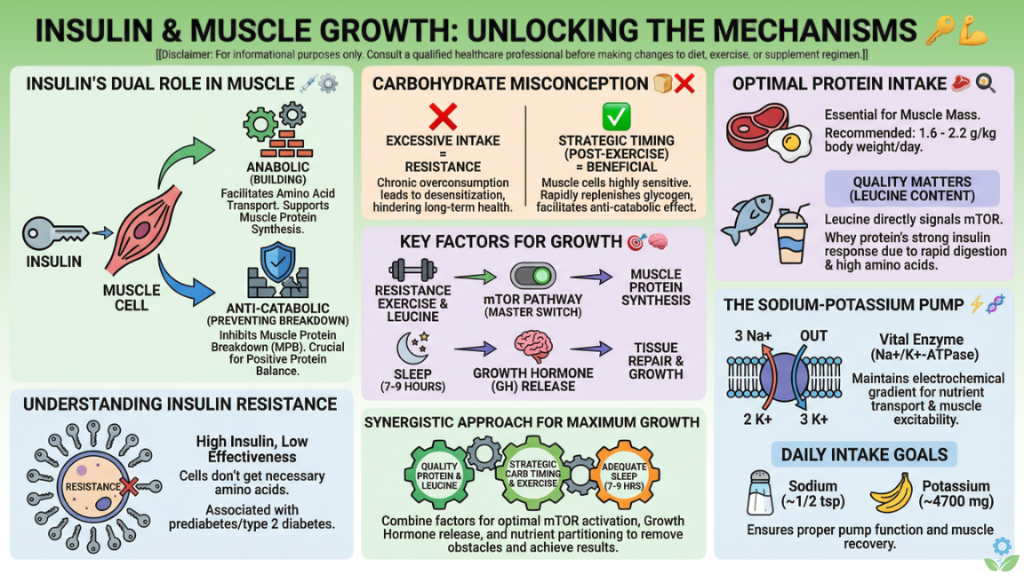
Insulin’s influence on muscle growth is a fundamental aspect of knowledge for people who want to maximize their muscle mass. Resistance to insulin, intake of carbohydrates, physical activity, sleep, consumption of protein, and the ratio of sodium to potassium – by taking care of all these factors, people can remove obstacles on their way and achieve the muscle growth they desire.
The best strategy to maximize muscle growth is essentially a combination of several methods working together: first to foremost a top-notch protein (a protein rich in Leucine) to stimulate the mTOR pathway, secondly using carbohydrates mainly during the workout periods to be able to recover quickly and to benefit from insulin’s anti-catabolic effect and thirdly to be able to get 7-9 hours of quality sleep for the most efficient release of the Growth Hormone.
Keep in mind that there is no formula that works for everyone, so it is necessary to try and find the method that suits you best.
Try Our Health & Fitness Tools
Find out how different exercises can be beneficial for you through your personal Health & Fitness Calculator that calculates BMR, TDEE, BMI, and daily calorie needs. Alternatively, you can use an Activity Calorie Calculator to get a rough idea of the calories that have been burned during your activity. There is more informative content and inspiration available for you at our Fitness & Body Transformation category to help you on your way to becoming a healthier version of yourself!
References
- Role of insulin in the regulation of human skeletal muscle protein synthesis and breakdown: a systematic review and meta-analysis. A S. M. A. M. van Eijik, et al. (2016). Diabetologia. [URL: https://link.springer.com/article/10.1007/s00125-015-3751-0]
- Insulin Stimulates Human Skeletal Muscle Protein Synthesis by Enhancing Net Amino Acid Uptake. KL Timmerman, et al. (2010 ). The Journal of Clinical Endocrinology & Metabolism. [URL: https://academic.oup.com/jcem/article-abstract/95/8/3848/2597043?redirectedFrom=fulltext&login=false]
- The Effect of Carbohydrate Intake on Strength and Resistance Training Performance: A Systematic Review. M Henselmans, et al. (2022 ). Nutrients. [URL: https://www.mdpi.com/2072-6643/14/4/856]
- Leucine: a nutrient signal for the regulation of protein synthesis in skeletal muscle. P M. Layman, et al. (2006 ). The Journal of Nutrition. [URL: https://academic.oup.com/jas/article/89/7/2004/4764185]
- The role of sleep in the regulation of hormones in the body. M Dattilo, et al. (2011 ). Sleep Science. [URL: https://pubmed.ncbi.nlm.nih.gov/22823399/]
- International Society of Sports Nutrition Position Stand: protein and exercise. J Antonio, et al. (2017 ). Journal of the International Society of Sports Nutrition. [URL: https://link.springer.com/article/10.1186/s12970-017-0177-8]
- The Na+, K+ pump in skeletal muscle: quantification, regulation and functional significance. T Clausen. (1996 ). Acta Physiologica Scandinavica. [URL: https://onlinelibrary.wiley.com/doi/10.1046/j.1365-201X.1998.0295e.x]


