


How to Reprogram Your Mind for Success 🧠🚀
Have you ever contemplated how successful people manage to maintain their positivity and focus even when they meet with hardships? The secret lies in their skill to understand how to reprogram their minds. The present blog will familiarize you with the notion of mind reprogramming along with a simple framework and some strategies that will…
Have you ever contemplated how successful people manage to maintain their positivity and focus even when they meet with hardships? The secret lies in their skill to understand how to reprogram their minds. The present blog will familiarize you with the notion of mind reprogramming along with a simple framework and some strategies that will enable you to dominate your thoughts and behaviors.
“Mind reprogramming” refers to the process by which a person uses the scientific principle of neuroplasticity—which is the brain’s capability to restructure itself by creating new neural pathways at any age to change one’s usual patterns of thinking and acting [1]. Such a change, which is under one’s control, is brought about by regular, purposeful mental and behavioral exercises.
The Power to Reprogram ⚡💭
There is a common adult misconception that reprogramming their minds is necessary, whereas what they actually need to do is to program it for the very first time. Our brains are regularly affected by patterns of events and situations which most of the time lead to automatic thoughts and behaviors and these are things we do not even realize. What is more, these automatic thoughts can also be in the form of negative and repetitive ones, which eventually results in the loss of control over our own minds.
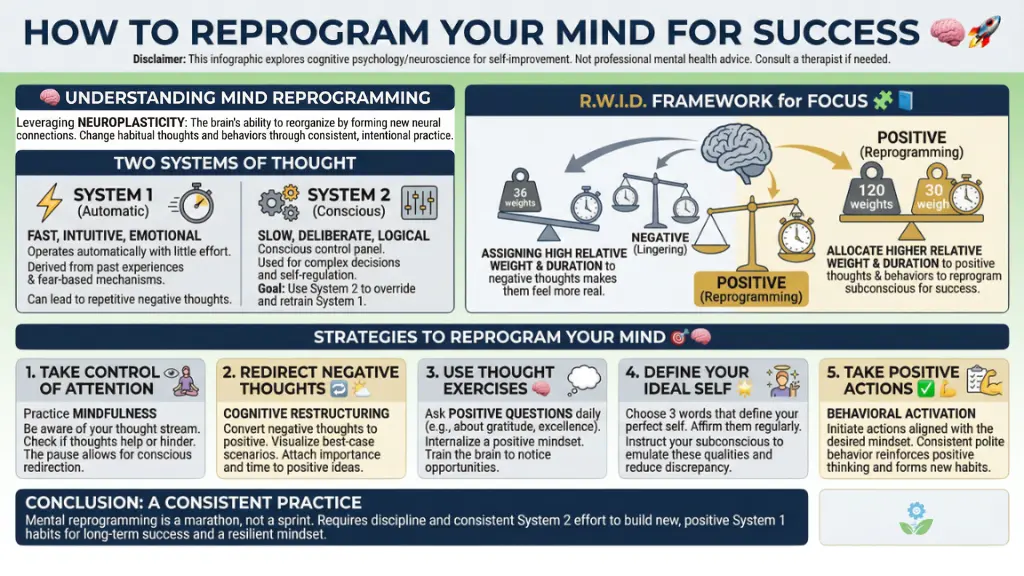
In order to have more power over and be in control of our minds, we should know the origin of our thoughts. Psychologists came up with the idea of two systems of thought. The first system includes automatic, unconscious, and immediate thoughts as well as impulses that come from the body and it is called System 1. More often than not, these thoughts are derived from the past experience or are fear-based help mechanisms. System 2, however, is our conscious control panel or the ability to generate our own thoughts and even behaviors at the given moment.

The dual-process theory of thought, which was majorly influenced by Nobel laureate Daniel Kahneman, points to two kinds of thinking – System 1 and System 2 [2]. System 1 being very rapid, intuitive, emotional, and it is just functioning automatically without almost no work being put in, it bases itself on heuristics and up-to-date experiences. System 2 is a slow, careful, logical, and it needs a conscious effort and focus, it is the brain control panel that we employ for complicated decision-making and self-control [2]. Reprogramming is basically the deliberate employment of System 2 to go beyond, and hence override and retrain, the automatic, frequently negative, reaction patterns of System 1.
How to Reprogram Your Mind with the R.W.I.D Framework 🧩📘
One of the ways we can better control our minds is by employing the R.W.I.D framework. This acronym stands for Relative Weight of Importance and Duration. The reason why negative recurring thoughts and feelings are able to linger is that we assign them a high relative weight and duration in our minds. We dwell on them and think about them over and over again thus, making them feel even more real.
Still, this framework is not powerless against us. On the contrary, we can utilize it to our benefit by allocating a higher relative weight and duration to positive thoughts and behaviors. Thus, we can reprogram our subconscious mind for success by turning our focus and attention to the positive sides of the situation.
Even though the R.W.I.D. framework serves as a good memory aid to concentrate one’s attention, the basic idea of it is actually one big attentional bias from psychology and the rule “neurons that fire together, wire together” from neuroscience [3]. If you keep giving “weight” (importance) and “duration” (time) to positive thoughts, you will thus keep on building the neural pathways that relate to those positive thoughts, so that those positive thoughts become your new automatic System 1 response.
Strategies to Reprogram Your Mind 🎯🧠
Take Control of Your Attention 👁️🗨️🧘♀️
Awareness of the stream of your thoughts and your current focus of attention is the initial step in learning how to reprogram your mind. Check your thoughts regularly during the day and find out if they help or hinder your progress. Mindfulness of your thoughts gives you the ability to manage them.
Mindfulness is a practice supported by science which, among other things, leads to better cognitive control as it allows people to better monitor their consciousness in a non-judgmental way [3]. Such an increased awareness is what gives the person a moment of silence between a System 1 stimulus (for example, a negative thought) and a System 2 reaction (for example, redirecting the thought), this being the very basis of self-regulation and mental reprogramming [3].
Redirect Negative Thoughts 🔄🌤️
Convert negative thoughts into positive ones. Understanding the opposite of a negative idea could help quite a bit. Picture the best-case scenario, and work on it. Attach a large amount of importance and time to this positive idea to make it familiar to your mind.
As an illustration, if a new opportunity makes you nervous, imagine a positive outcome and concentrate on how to make it happen. To the extent that you change your thought pattern and concentrate on the positive, you acquire personal power and mastery over your mind for mind success.
This method is actually called one of the major parts of CBT, Cognitive Restructuring, which is a form of Cognitive Behavioral Therapy (CBT) [4]. The process is about recognizing cognitive distortions (irrational thought patterns), questioning their truth with facts, and changing them for the most balanced, realistic, and even positive alternative thoughts [4].
Use Thought Exercises 🧠💭
One can reprogram their mind using thought exercises. Think of five positive questions and ask yourself these questions three or four times a day. The questions must be connected to gratitude, surprise, fun, love, or excellence. By interacting with these questions one internalizes the positive mindset. Define Your Ideal Self.
The use of positive questions is a technique derived from Appreciative Inquiry and positive psychology, which focuses on leveraging strengths and positive core rather than deficits [5]. So, when you constantly ask your mind to find positive answers, you actually teach the brain’s Reticular Activating System (RAS) that it has to look for and be aware of positive opportunities and experiences in the surrounding.
Define Your Ideal Self 🌟🙌
What are three words that define your ideal self? The words must reflect the features and the attributes of the perfect self. To keep your desired self always in mind, utter those words to yourself occasionally. When you constantly link yourself with these qualities, you are actually instructing your subconscious to emulate your ideal self.
Defining the “Ideal Self” is a key component of Self-Discrepancy Theory and is used in coaching and motivational psychology to create a clear target for change [6]. One factor that makes this a powerful source of motivation, is the reduction of the discrepancy between the present and the ideal self, which happens as a result of the consistent affirmation of these characteristics.
Take Positive Actions ✅💪
Actions, without a doubt, have a major influence in the process of mental reprogramming. Initiate positive actions that are in harmony with the mindset and behavior you wish to have. Through polite behavior over and over again, your brain becomes acquainted with positive thinking. Don’t forget that actions may have just as much influence as thoughts when it comes to changing your mind.
This emphasizes the principle of Behavioral Activation, which suggests that changing behavior can often precede and facilitate a change in mood and thought patterns [7]. The brain perceives a series of positive behaviors as proof of the new “self” that is reinforcing the neural pathways associated with the change and eventually making the new mindset automatic.
Conclusion
Mental reprogramming is a psychological instrument that can lead to personal success. By learning how to reprogram your mind through the R.W.I.D framework and putting into practice the strategies referred to, you can become the master of your thoughts and conduct.
Keep in mind that it is a slow process, nevertheless, if you are consistent and have discipline, you will be able to reprogram your mind so that it becomes a source of support for your goals and dreams.
Success in mental reprogramming is a marathon, not a sprint, requiring the consistent application of System 2 effort to build new, positive System 1 habits [2]. The eventual prize is a mindset that is stronger, more concentrated, and optimistic, and in total harmony with your definition of success.
Even more useful information for your brain and mental health — read it here!
References
- Neuroplasticity: The brain that changes itself. N. Doidge. (2007). Penguin Books. [Popular science book summarizing the concept.]
- Thinking, Fast and Slow. D. Kahneman. (2011). Farrar, Straus and Giroux. [Foundational text on System 1 and System 2 thinking.]
- The Organization of Behavior: A Neuropsychological Theory. D. O. Hebb. (1949). Wiley. [Source of the principle “neurons that fire together, wire together.”]
- Mindfulness Enhances Cognitive Functioning: A Meta-Analysis. N. H. Zainal, et al. (2023). Frontiers in Psychology. [URL: https://pmc.ncbi.nlm.nih.gov/articles/PMC10902202/]
- Cognitive Restructuring in Cognitive Behavioral Therapy. A. Gragnani, et al. (2018 ). In: Cognitive Behavioral Therapy: Techniques and Strategies. [URL: https://www.researchgate.net/publication/237404587_A_Positive_Revolution_in_Change_Appreciative_Inquiry]
- Appreciative Inquiry: A Positive Revolution in Change. D. L. Cooperrider, et al. (2008 ). Berrett-Koehler Publishers. [Foundational text on Appreciative Inquiry.]
- Self-Discrepancy: A Theory Relating Self and Affect. E. T. Higgins. (1987). Psychological Review. [Foundational theory for the Ideal Self concept.]
- Behavioral activation for depression: a contemporary review. S. M. Dimidjian, et al. (2011). Annual Review of Clinical Psychology. [URL: https://www.annualreviews.org/content/journals/10.1146/annurev-clinpsy-032210-104535]


